Before visiting a car dealership, it’s very important to prepare yourself by understanding what to
expect during the buying process. Being informed can help you avoid costly mistakes, make confident
decisions, and achieve a better overall outcome. "Don't enter the vehicle purchasing process without proper preparation."
DIY(Do-It-Yourself) :
Tips for getting a better outcome at a car dealership.
Here are some of the things you should know and expect at a car dealership.
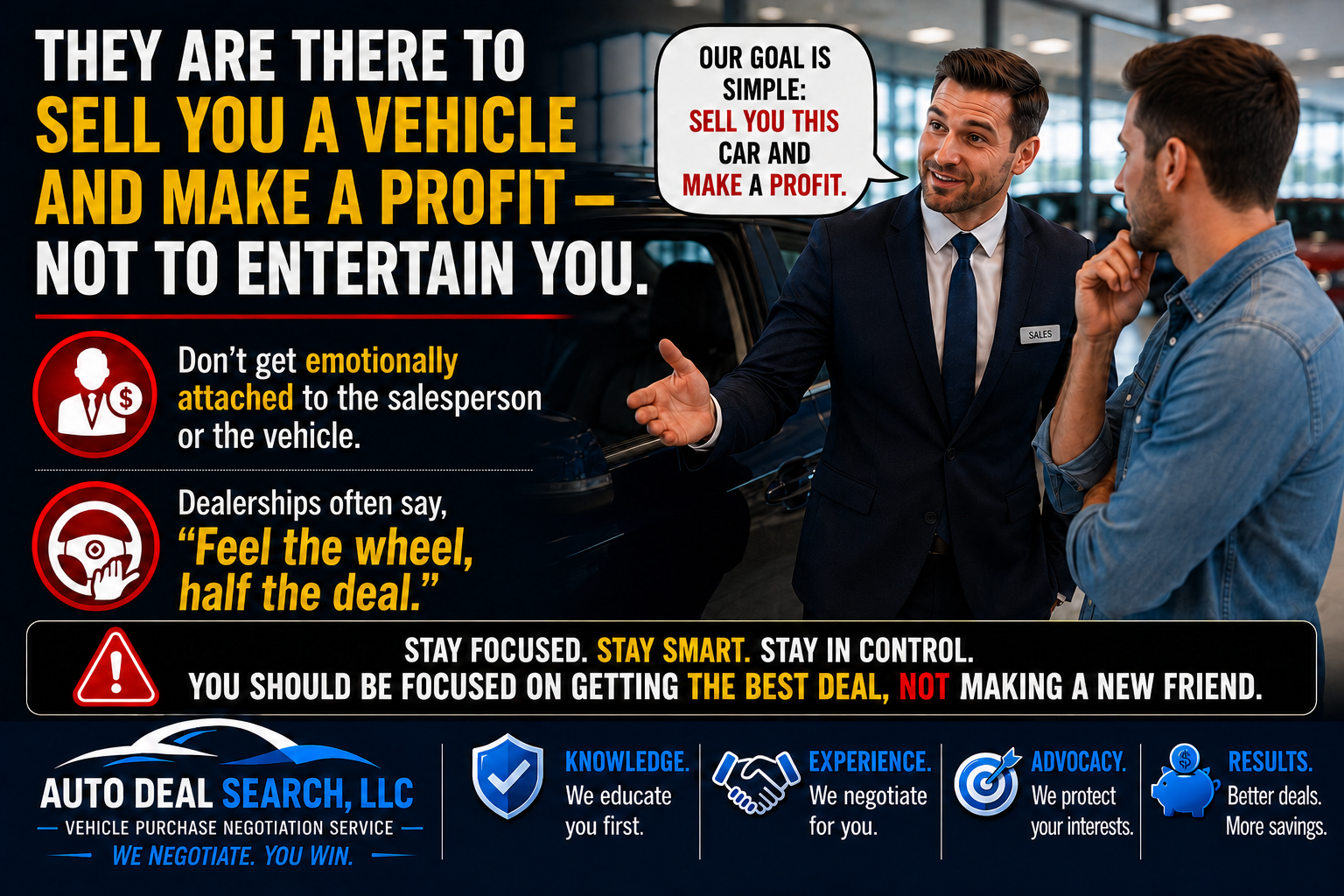
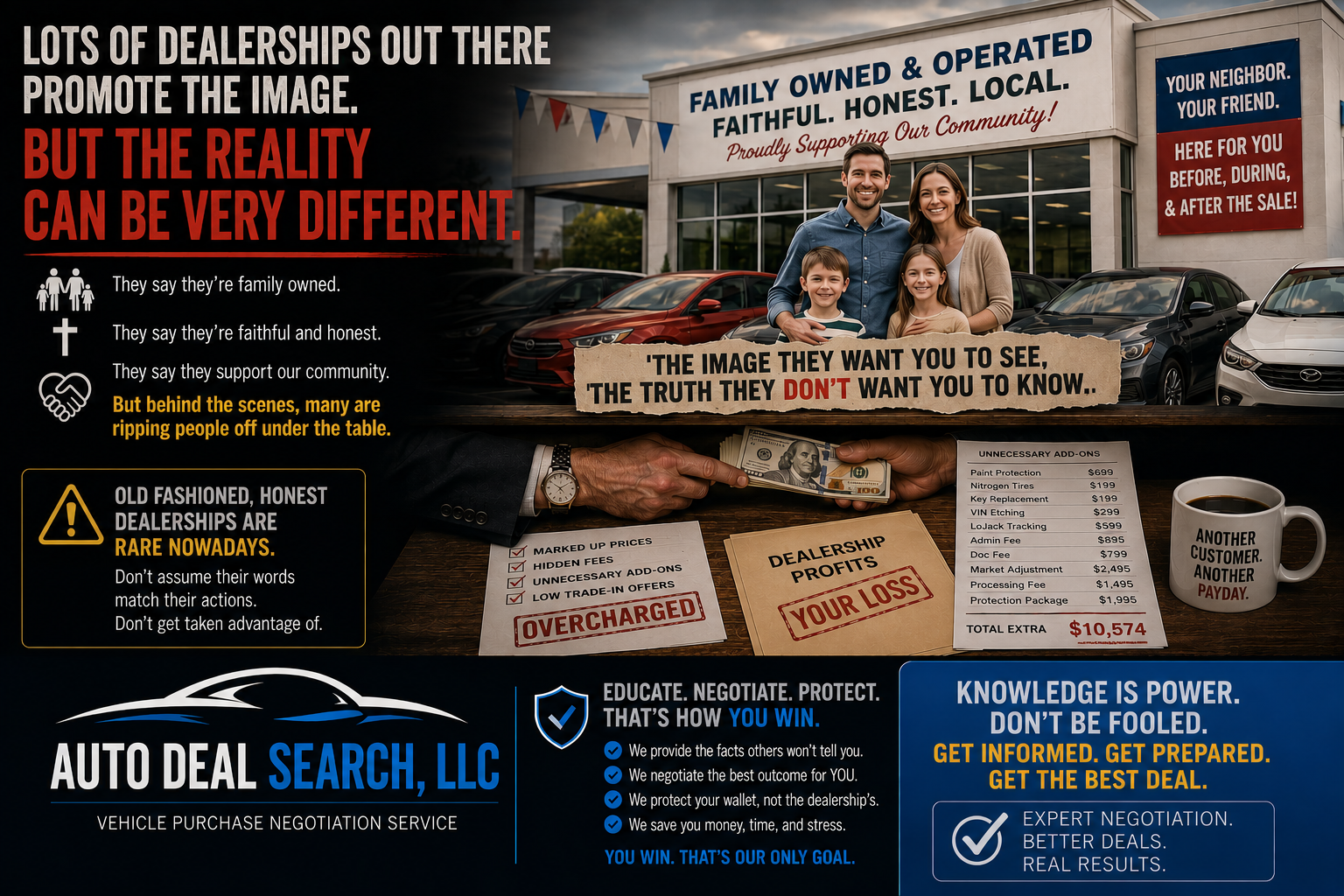
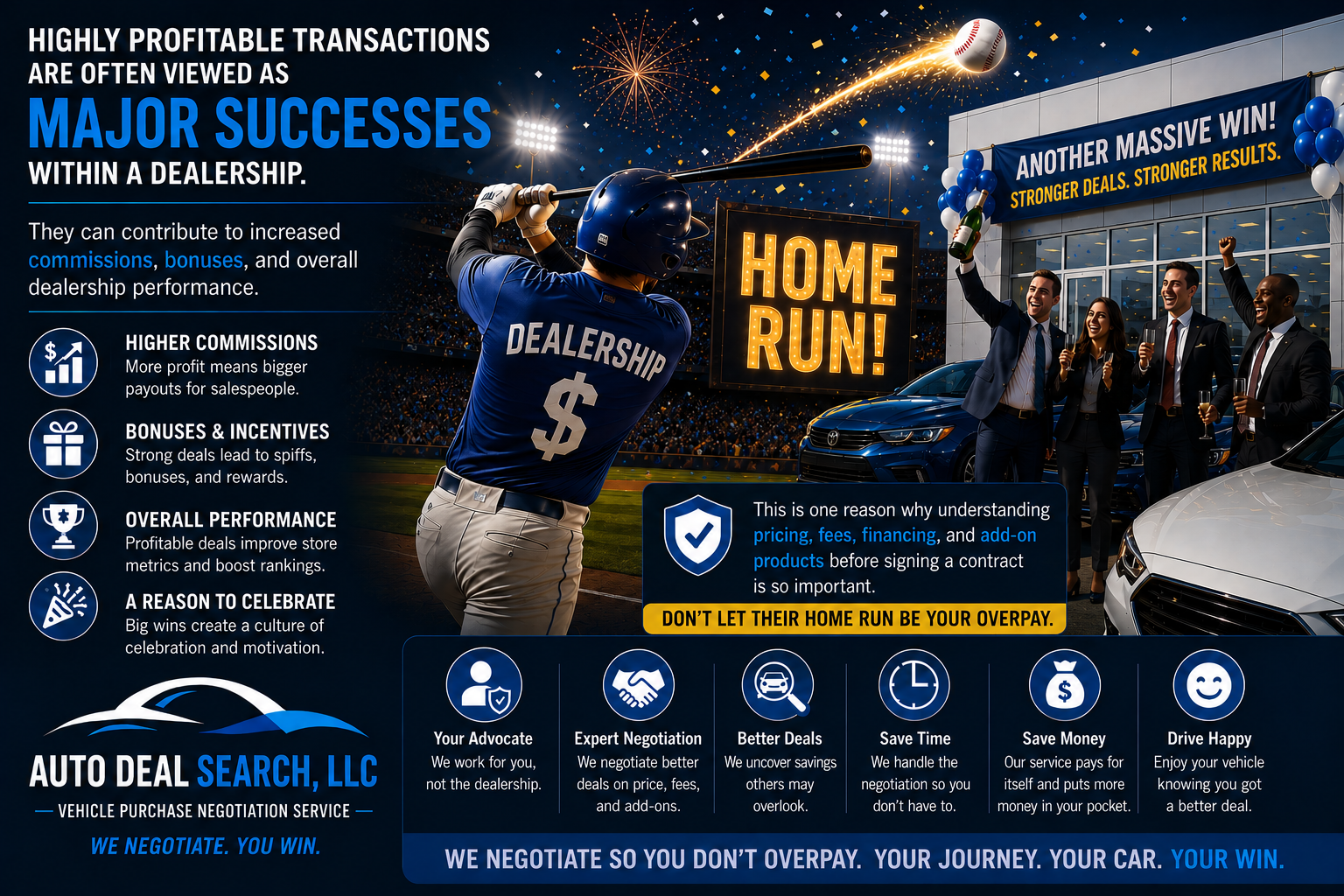
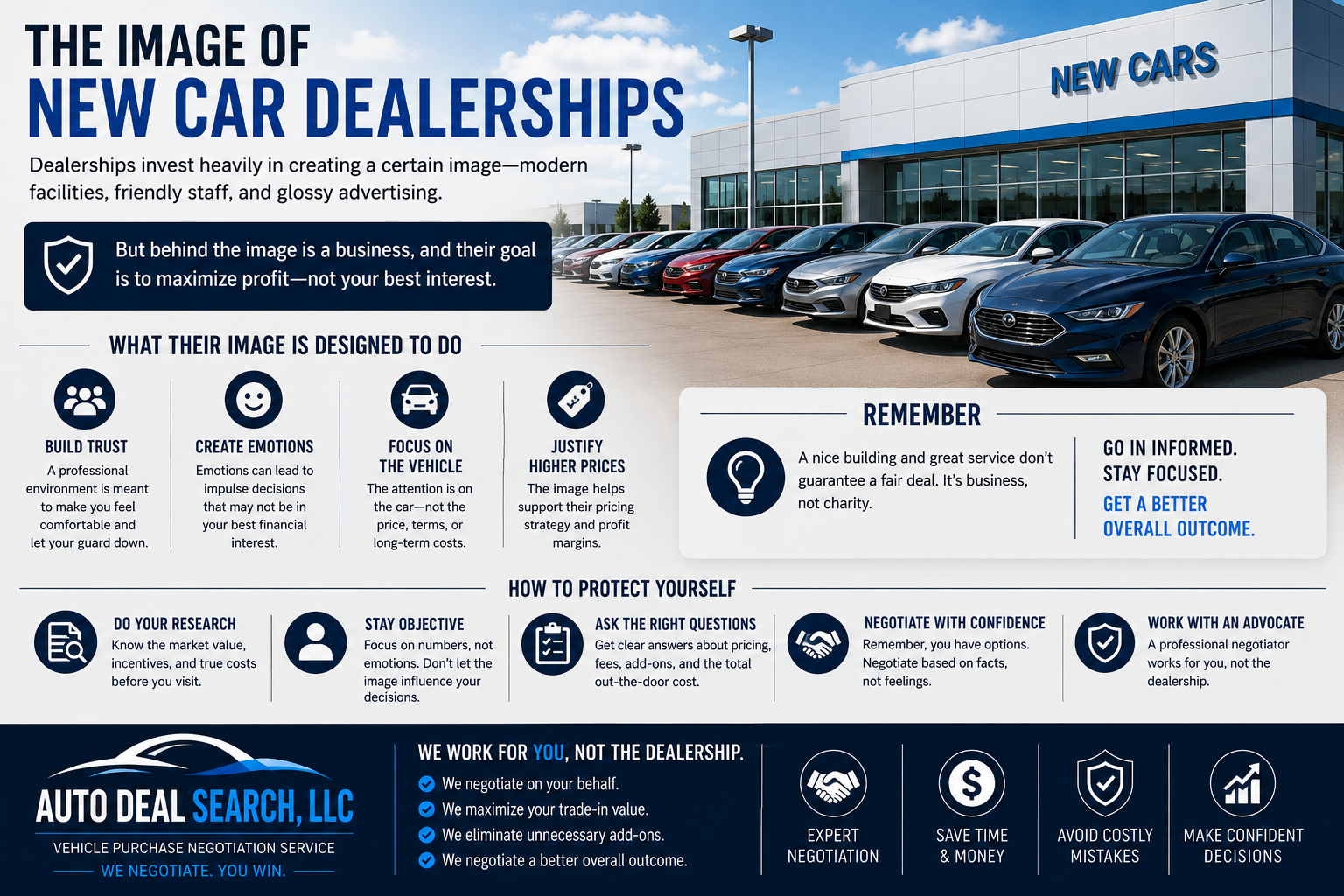
*Remember that dealerships are businesses focused on selling vehicles and generating profit.
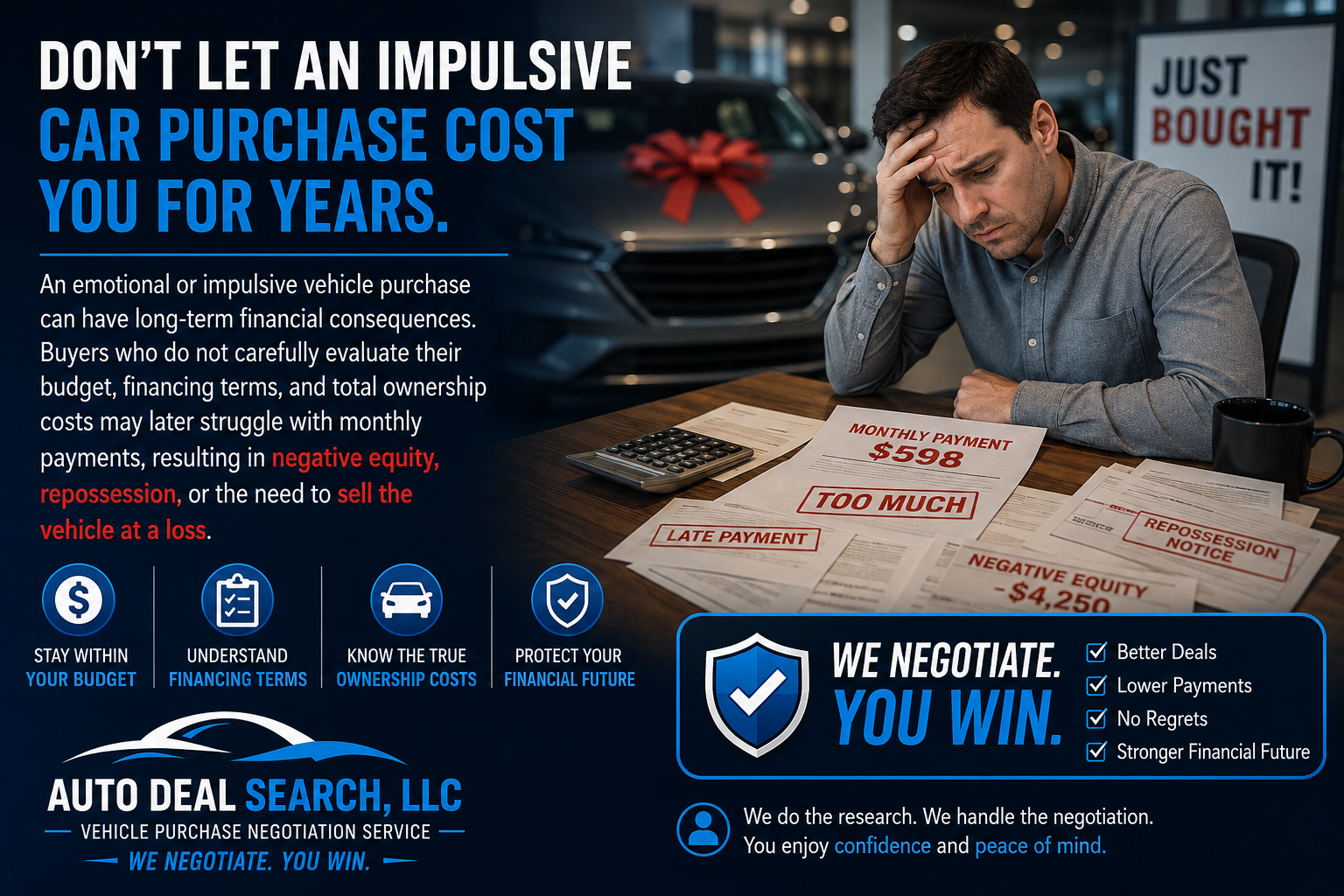
-Try to remain objective and avoid making emotionally driven purchasing decisions. Dealerships often say, “Feel the wheel, half the deal.”
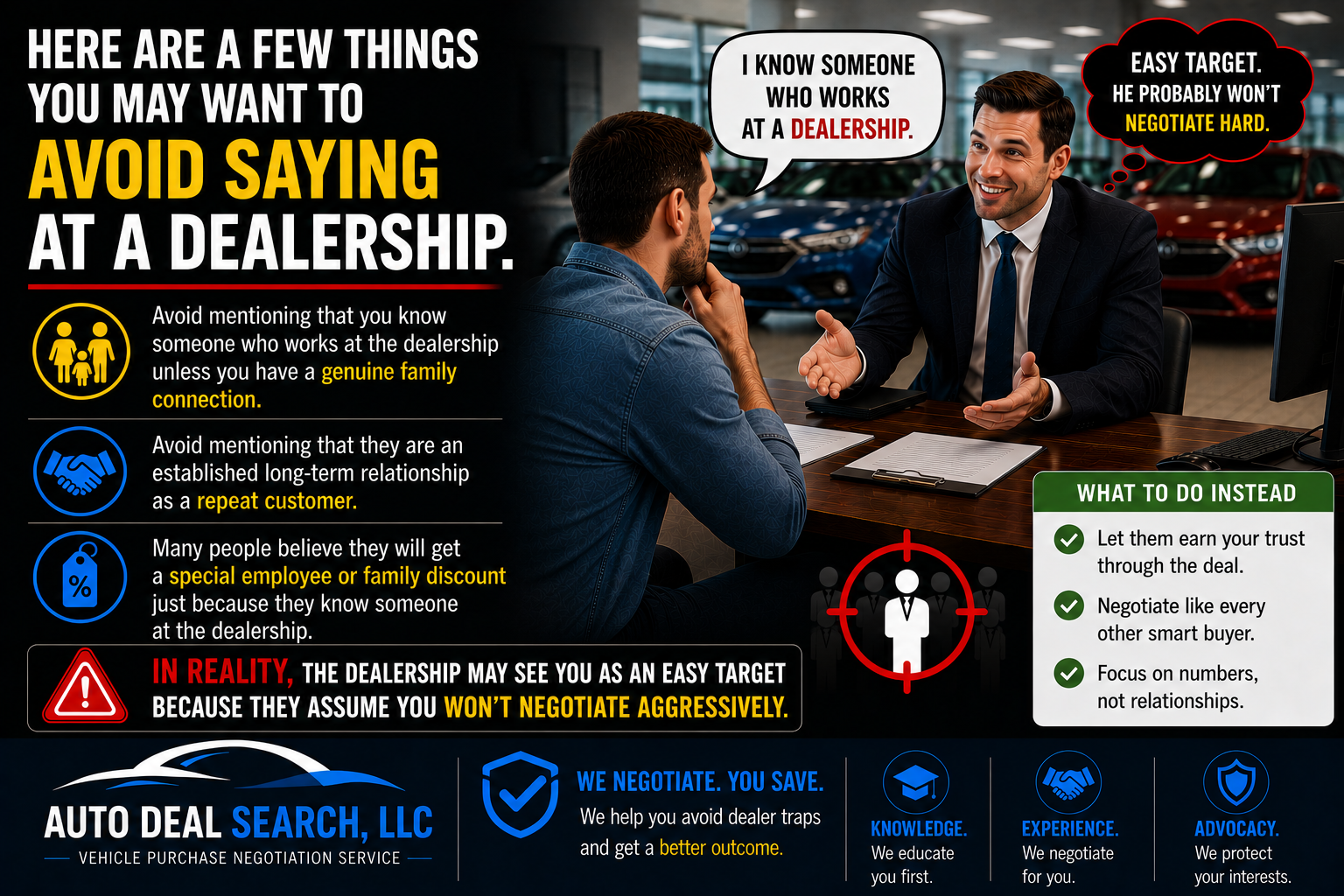
*Here are a few things you may want to avoid saying at a dealership.
-Avoid mentioning that you know someone who works at the dealership unless you have a genuine family connection or an established long-term
relationship as a repeat customer. Many people believe they will get a special employee or family discount just because they know someone at the
dealership. In reality, the dealership may see you as an easy target because they assume you won’t negotiate aggressively.
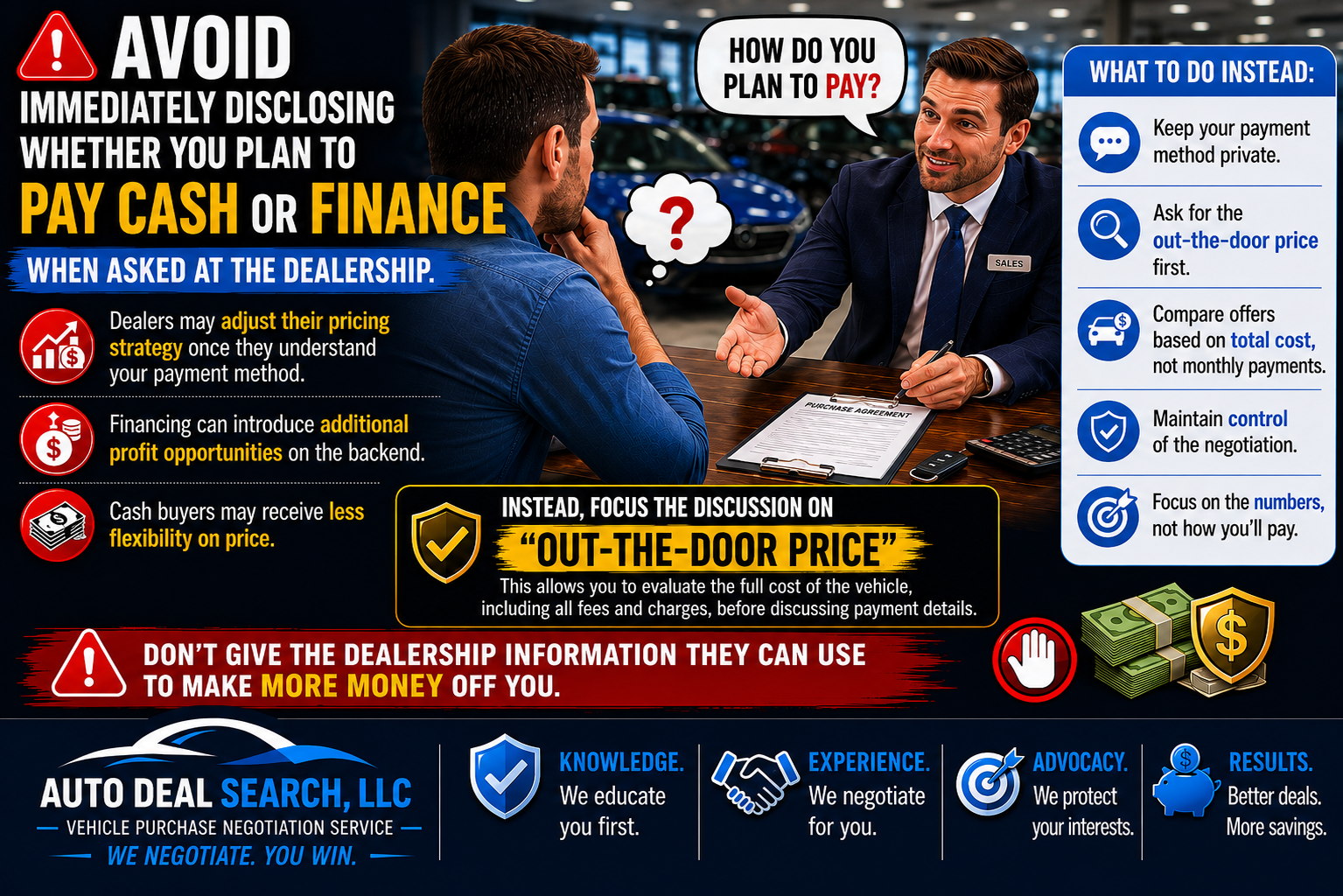
-Avoid immediately disclosing whether you plan to pay cash or finance when asked at the dealership. Dealers may adjust their pricing strategy once
they understand your payment method, as financing can introduce additional profit opportunities on the backend, while cash buyers may receive
less flexibility on price. Instead, consider focusing the discussion on the “out-the-door price,” which allows you to evaluate the full cost of the vehicle,
including all fees and charges, before discussing payment details.
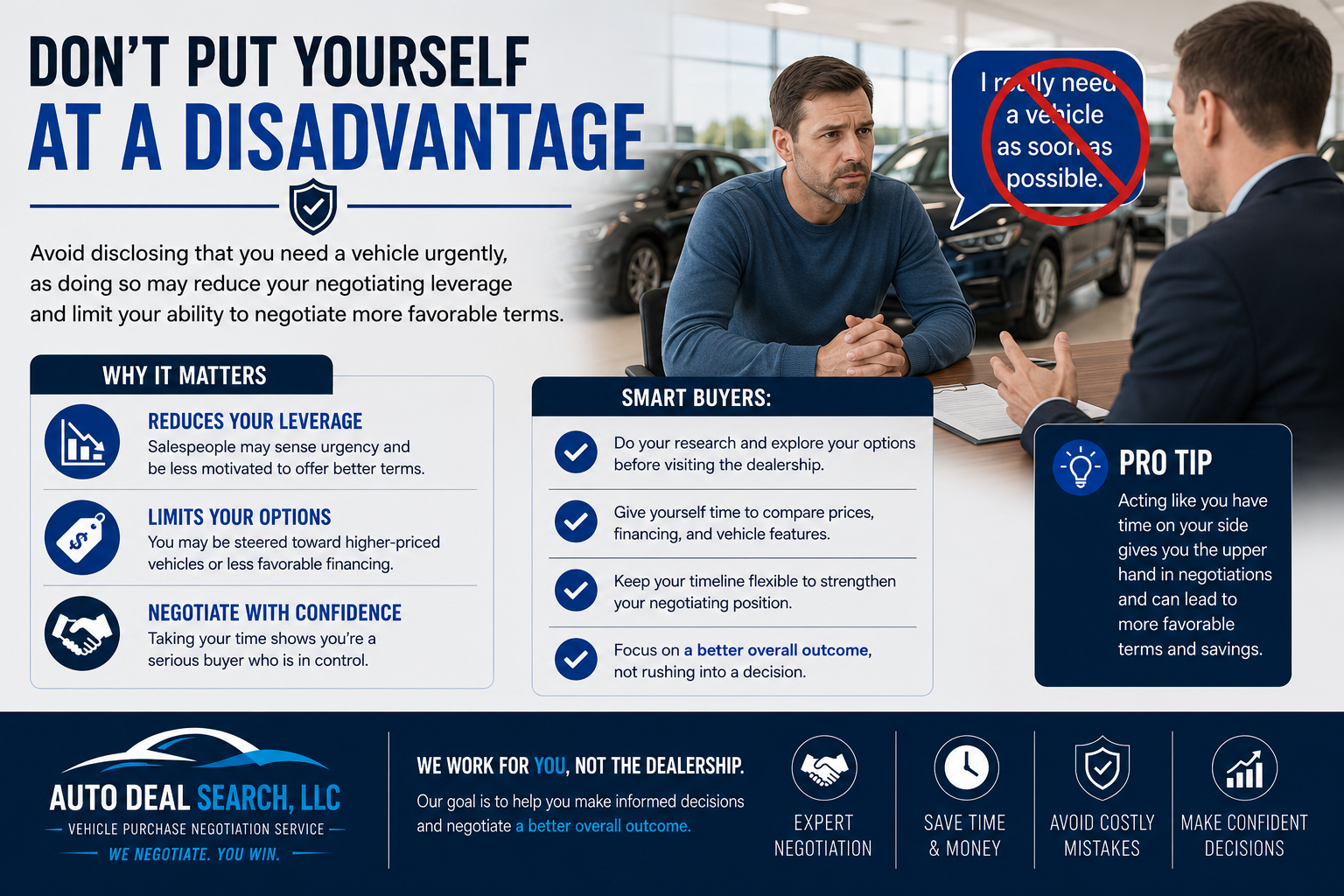
-Avoid disclosing that you need a vehicle urgently, as doing so may reduce your negotiating leverage and limit your ability to negotiate more favorable terms.
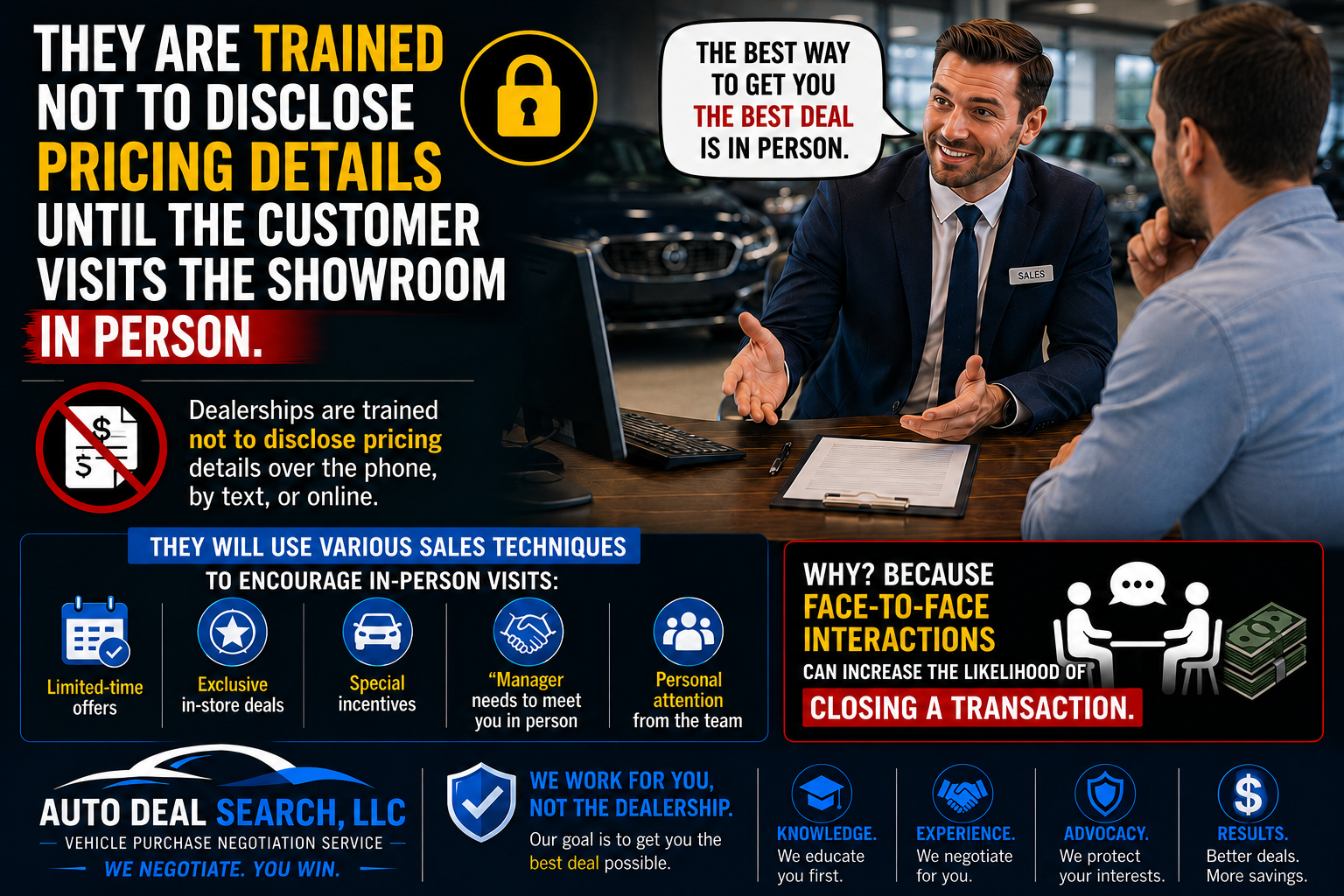
*They are trained not to disclose pricing details until the customer visits the showroom in person.
-They will use various sales techniques to encourage in-person visits, as face-to-face interactions can increase the likelihood of closing a transaction.
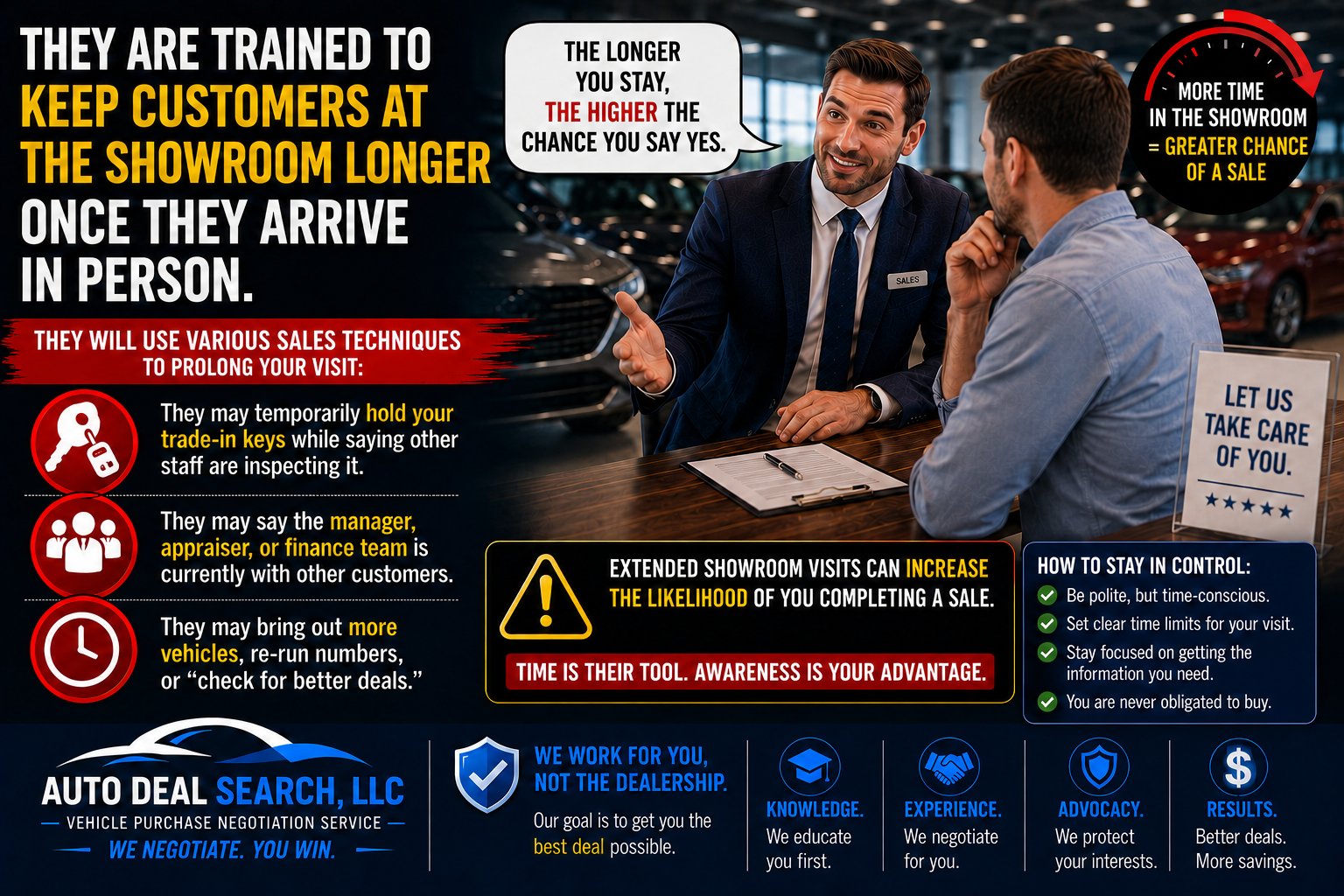
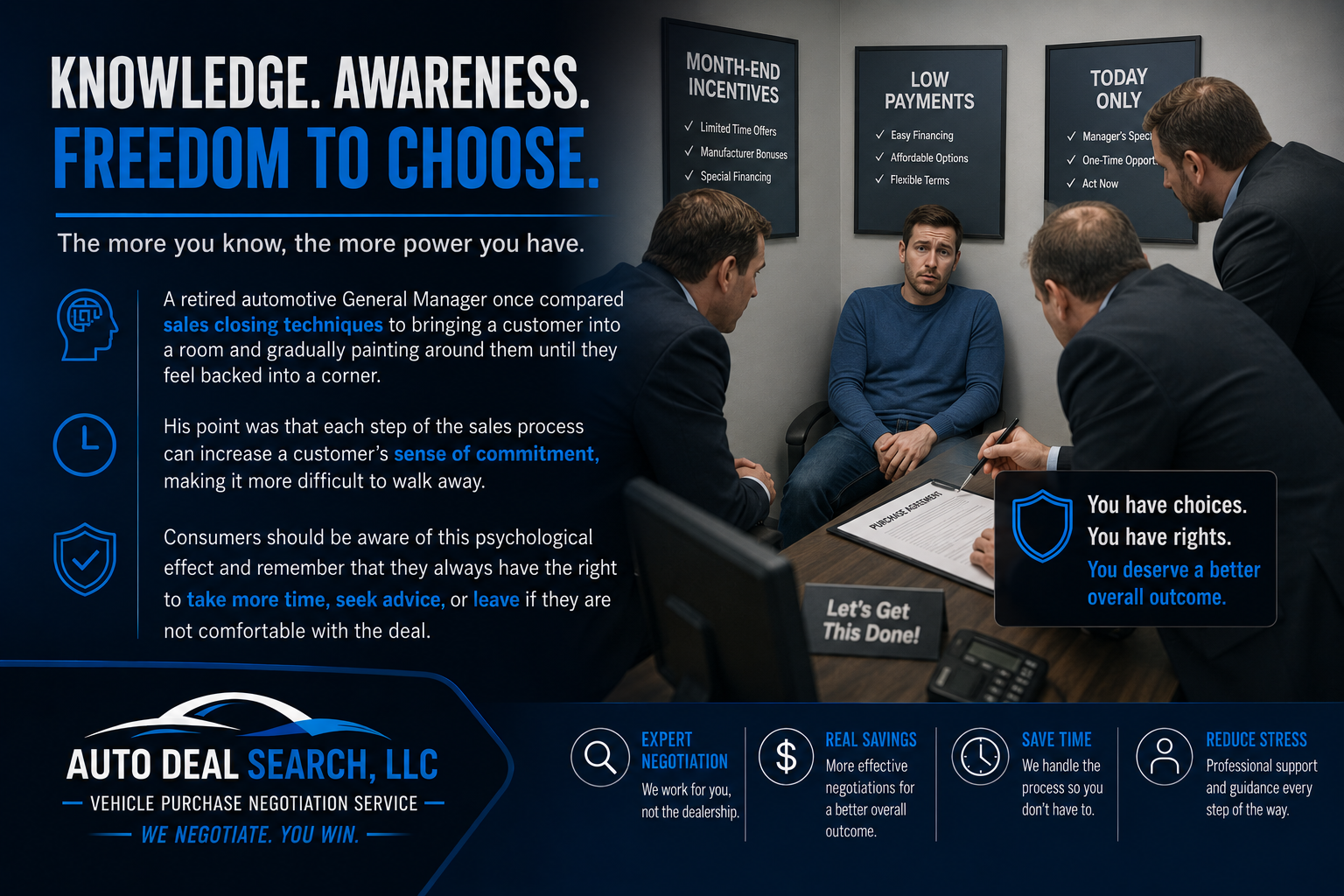
*Dealership sales processes are often designed to encourage customers to spend more time in the showroom before making a decision.
-They will use various sales techniques to prolong a customer’s visit, such as temporarily holding trade-in vehicle keys while stating that additional
staff members are inspecting the vehicle, as extended showroom visits can increase the likelihood of completing a sale.
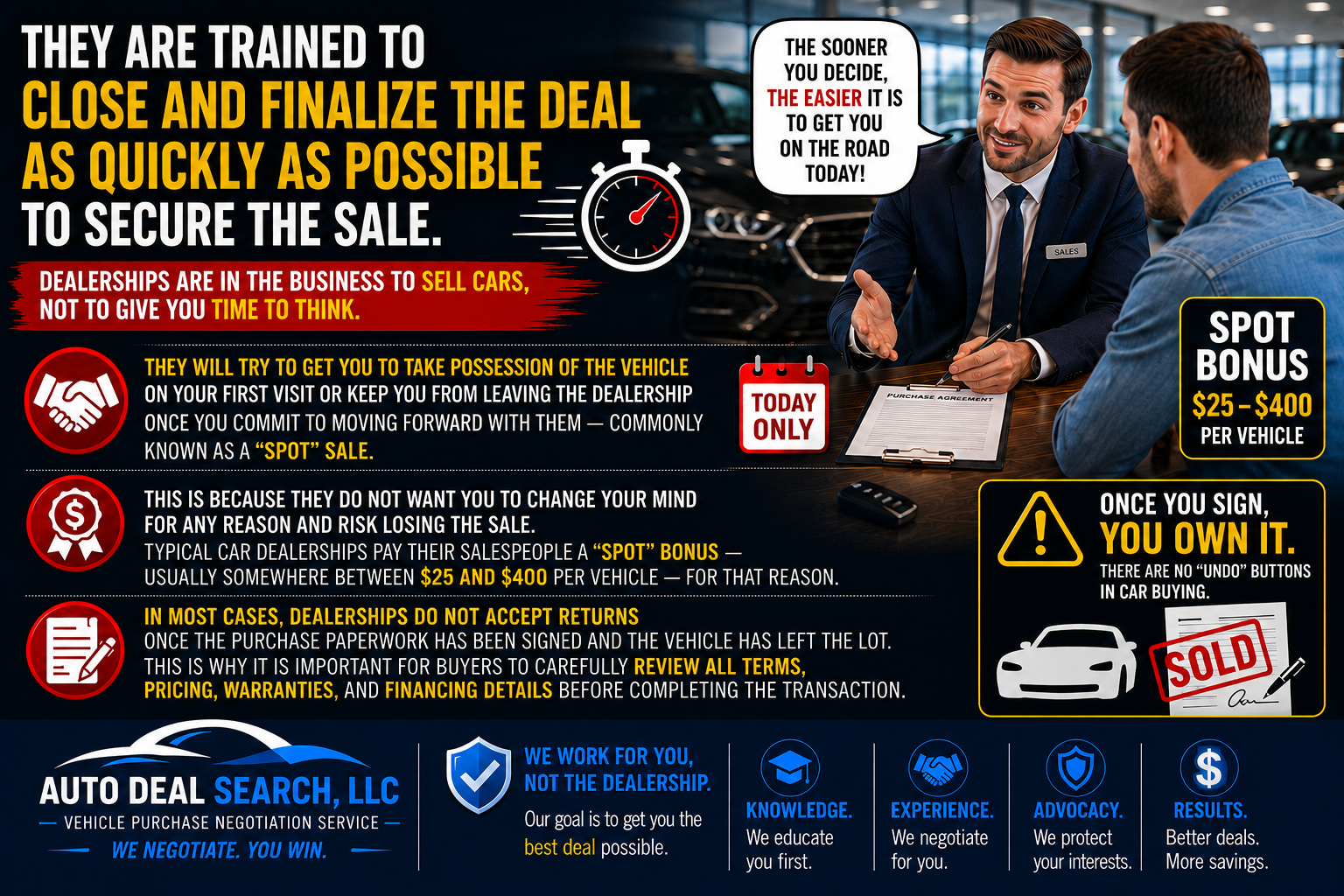
*They are trained to close and finalize the deal as quickly as possible to secure the sale.
-They will try to get you to take possession of the vehicle on your first visit or keep you from leaving the dealership once you commit to moving
forward with them — commonly known as a “spot” sale. This is because they do not want you to change your mind for any reason and risk losing
the sale. Typical car dealerships pay their salespeople a “spot” bonus — usually somewhere between $25 and $400 per vehicle — for that reason.
-In most cases, dealerships do not accept returns once the purchase paperwork has been signed and the vehicle has left the lot. This is why it is
important for buyers to carefully review all terms, pricing, warranties, and financing details before completing the transaction.
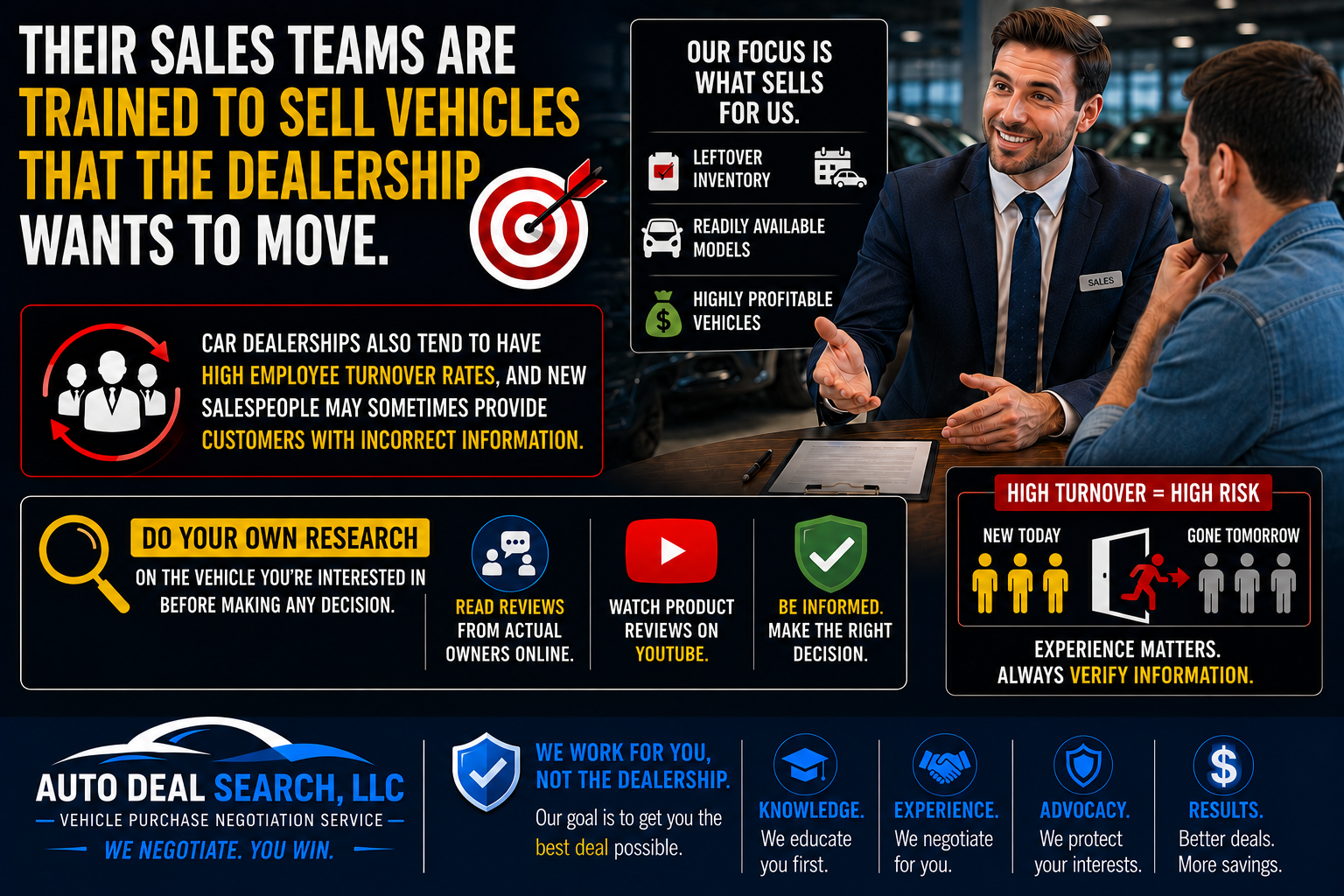
*Their sales teams are trained to sell vehicles that the dealership wants to move — such as leftover inventory, readily available models,
or highly profitable vehicles.
-Do your own research on the vehicle you’re interested in by reading reviews from actual owners online and watching product reviews on platforms
like YouTube before making any decision.
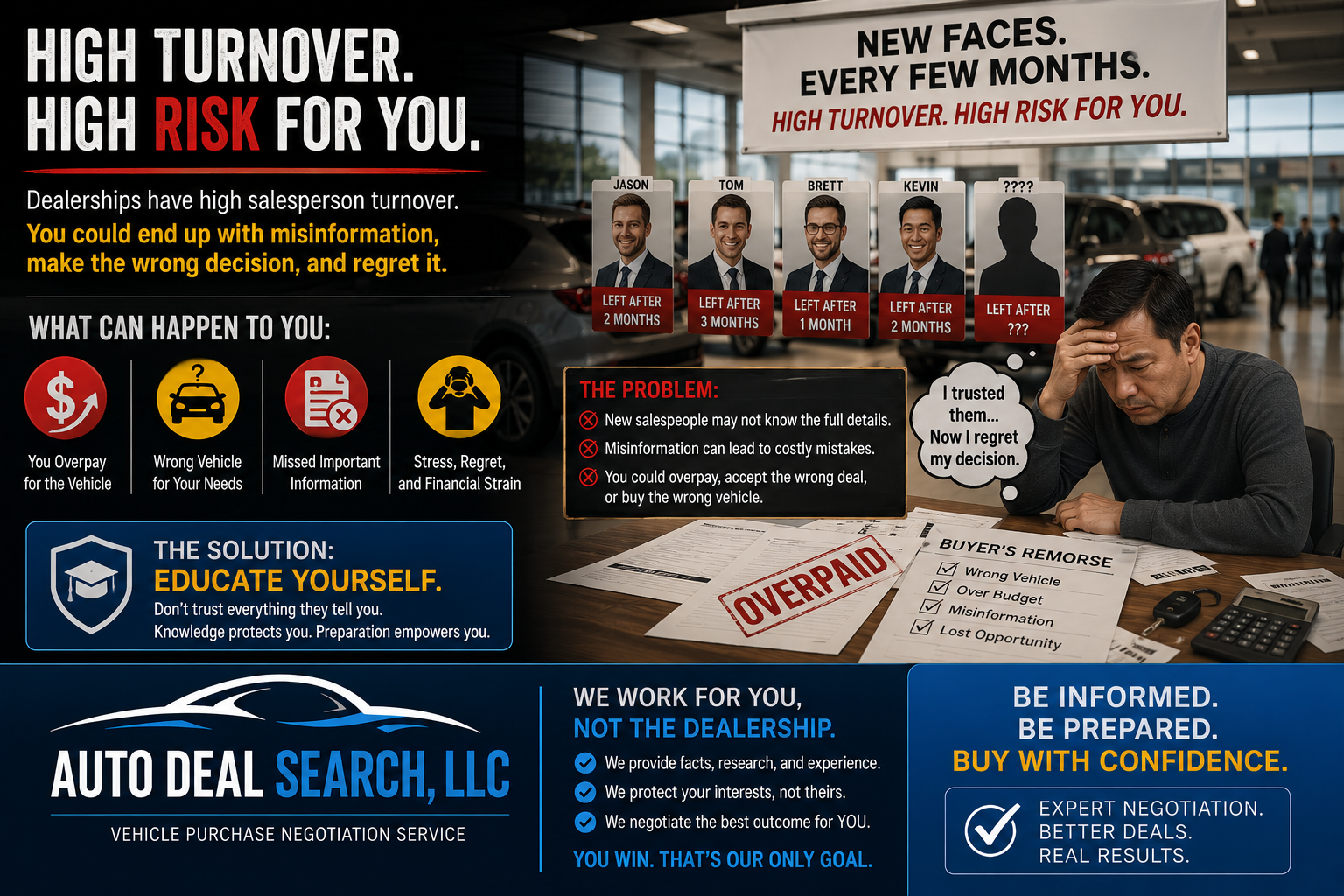
*Car dealerships tend to have high employee turnover rates, and new salespeople may sometimes provide customers with incorrect
information.
-Do your own research on the vehicle you’re interested in by reading reviews from actual owners online and watching product reviews on platforms
like YouTube before making any decision..
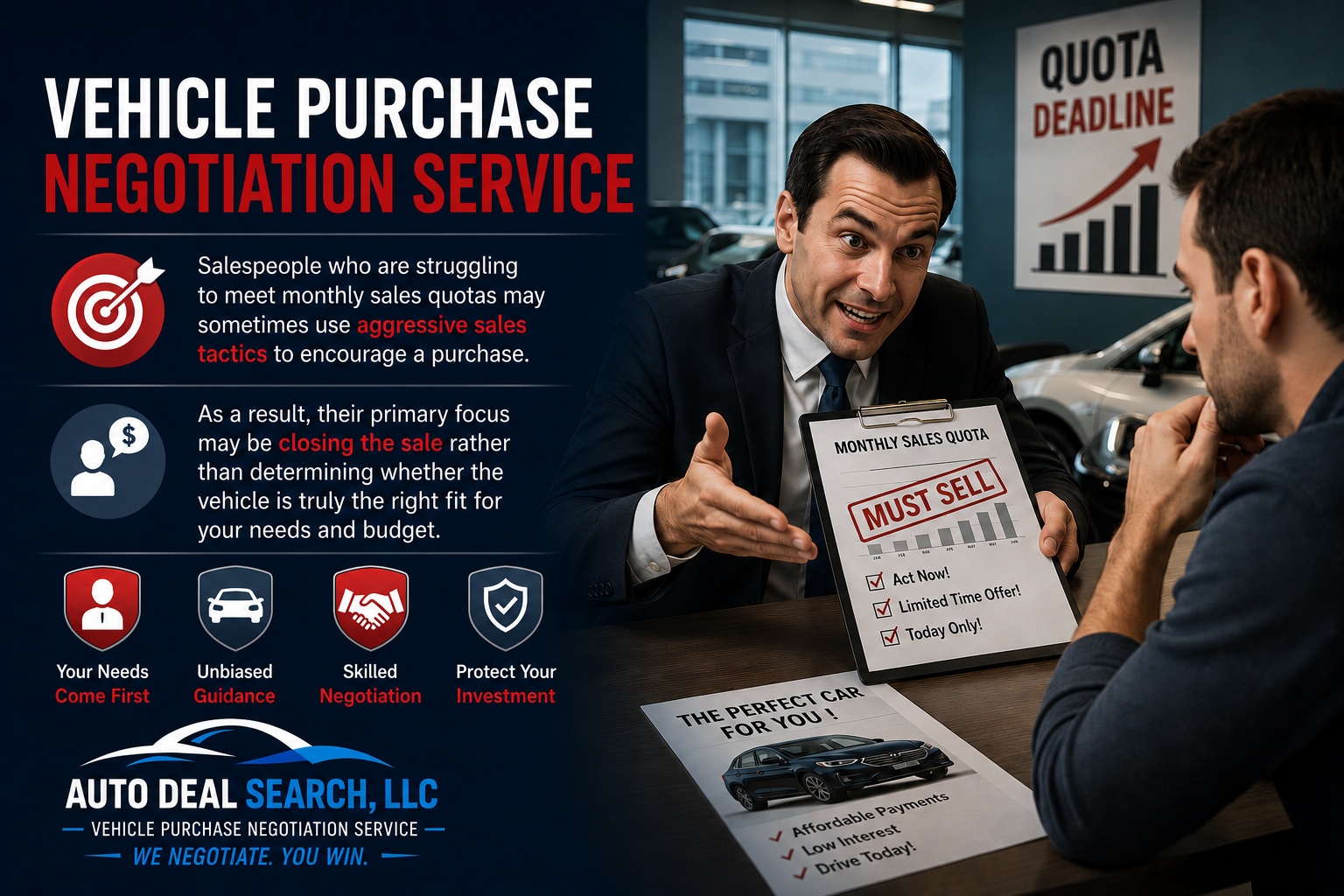
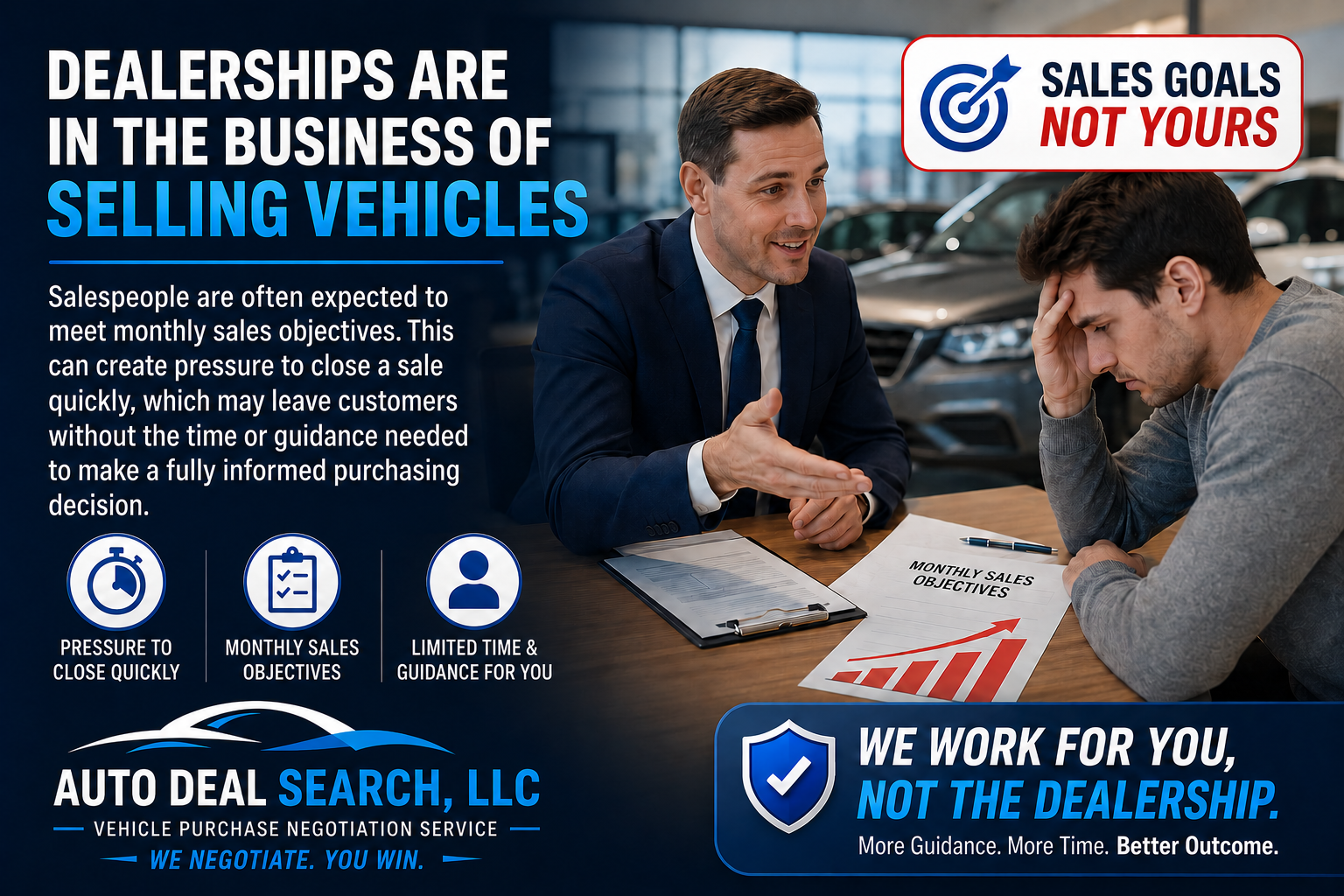
*Salespeople who are struggling to meet monthly sales quotas may sometimes use aggressive sales tactics to encourage a purchase.
As a result, their primary focus may be closing the sale rather than determining whether the vehicle is truly the right fit for your needs
and budget.
-Do your own research on the vehicle you’re interested in by reading reviews from actual owners online and watching product reviews on platforms
like YouTube before making any decision.
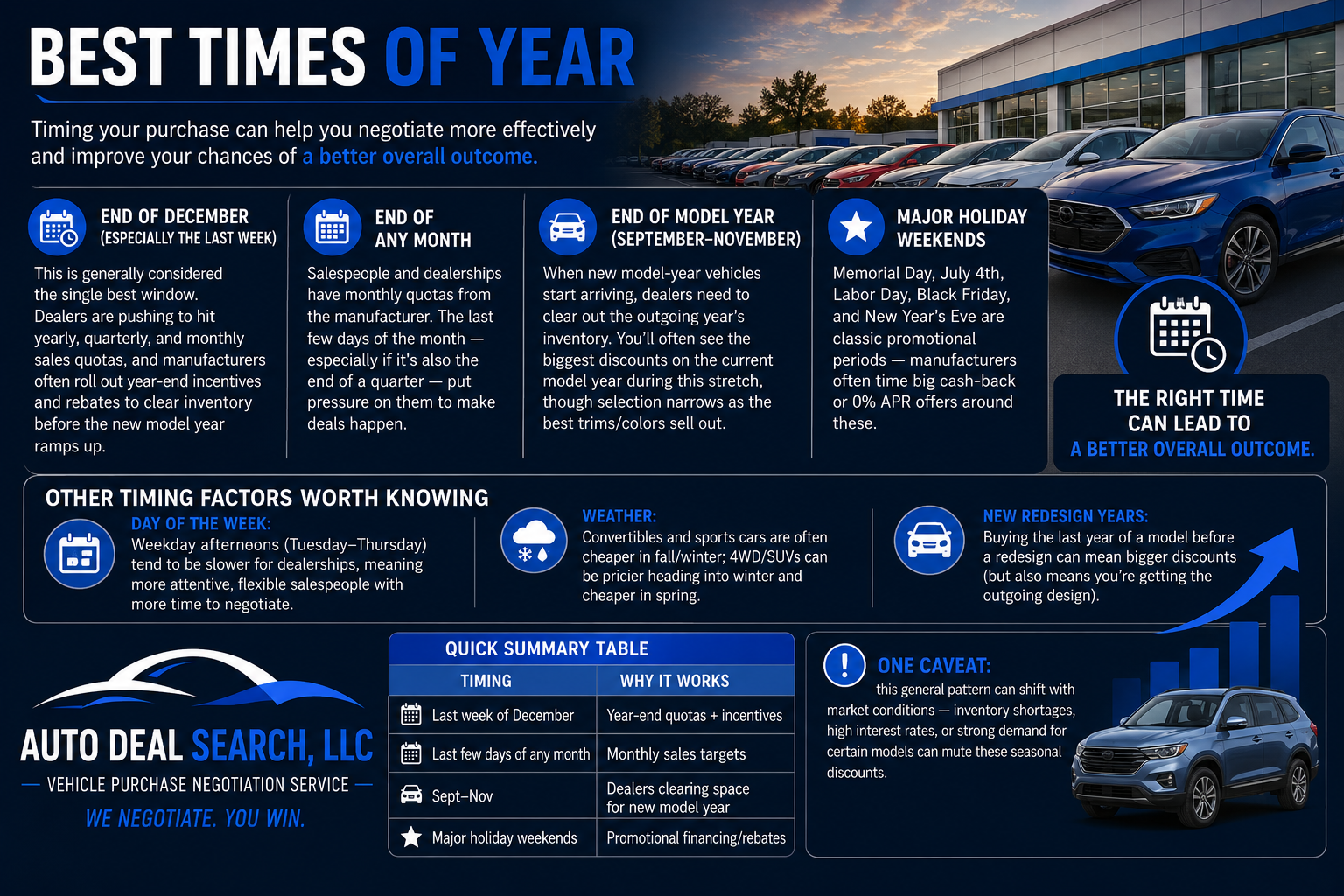
*Best times of year
End of December (especially the last week)
This is generally considered the single best window. Dealers are pushing to hit yearly, quarterly, and monthly sales quotas, and manufacturers often roll out year-end incentives and rebates to clear inventory before the new model year ramps up.
End of any month
Salespeople and dealerships have monthly quotas from the manufacturer. The last few days of the month — especially if it's also the end of a quarter — put pressure on them to make deals happen.
End of model year (September–November)
When new model-year vehicles start arriving, dealers need to clear out the outgoing year's inventory. You'll often see the biggest discounts on the current model year during this stretch, though selection narrows as the best trims/colors sell out.
Major holiday weekends
Memorial Day, July 4th, Labor Day, Black Friday, and New Year's Eve are classic promotional periods — manufacturers often time big cash-back or 0% APR offers around these.
Other timing factors worth knowing
-Day of the week : Weekday afternoons (Tuesday–Thursday) tend to be slower for dealerships, meaning more attentive, flexible salespeople with more time to negotiate.
-Weather : Convertibles and sports cars are often cheaper in fall/winter; 4WD/SUVs can be pricier heading into winter and cheaper in spring.
-New redesign years : Buying the last year of a model before a redesign can mean bigger discounts (but also means you're getting the outgoing design).
Quick summary table
Timing : Why it works :
-Last week of December -Year-end quotas + incentives
-Last few days of any month -Monthly sales targets
-Sept–Nov -Dealers clearing space for new model year
-Major holiday weekends -Promotional financing/rebates
One caveat : this general pattern can shift with market conditions — inventory shortages, high interest rates, or strong demand for certain models can mute these seasonal discounts.
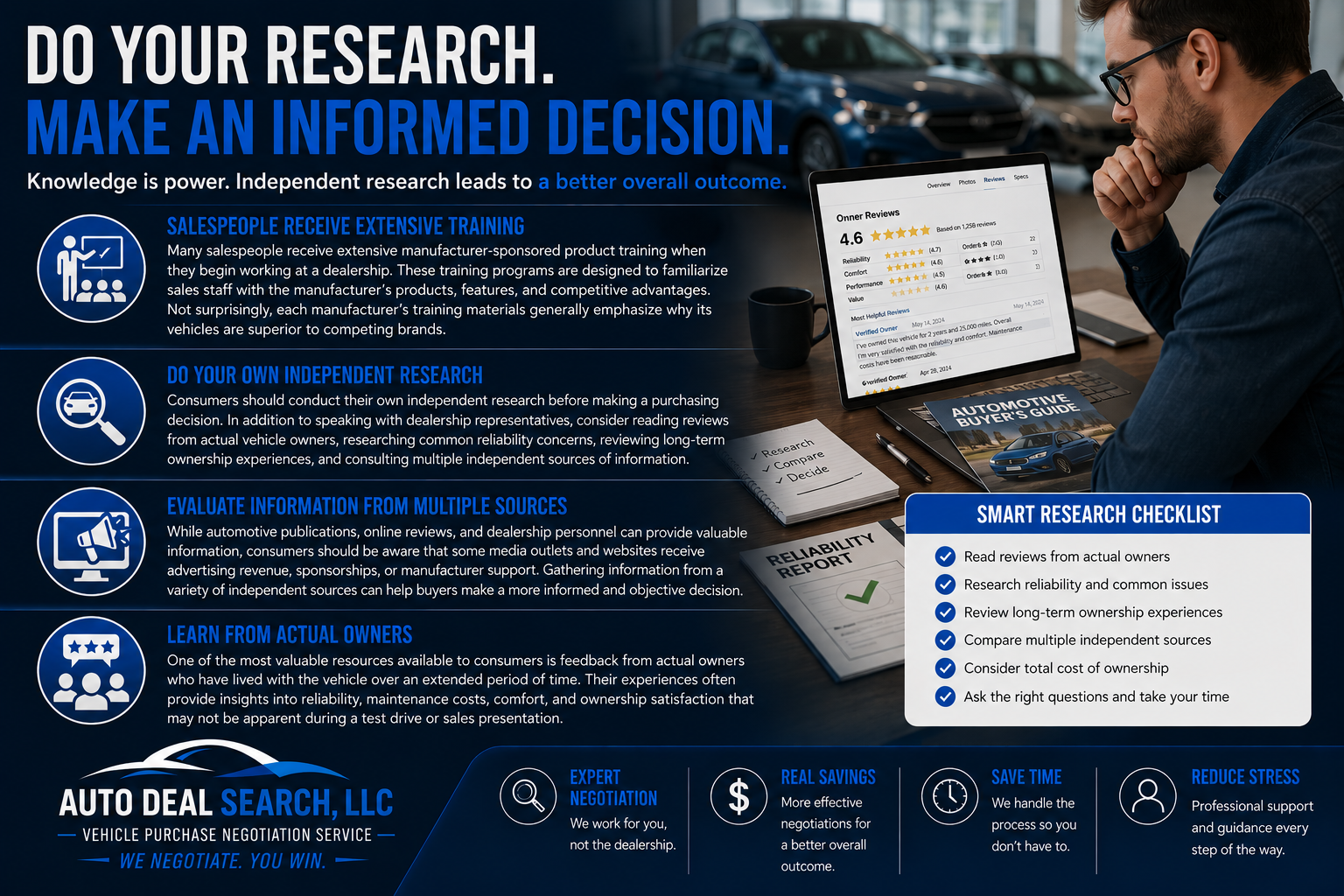
*Research vehicle owner reviews before buying a car
-Many salespeople receive extensive manufacturer-sponsored product training when they begin working at a dealership. These training programs are designed to familiarize sales staff with the manufacturer's products, features, and competitive advantages. Not surprisingly, each manufacturer's training materials generally emphasize why its vehicles are superior to competing brands. For this reason, consumers should conduct their own independent research before making a purchasing decision. In addition to speaking with dealership representatives, consider reading reviews from actual vehicle owners, researching common reliability concerns, reviewing long-term ownership experiences, and consulting multiple independent sources of information. While automotive publications, online reviews, and dealership personnel can provide valuable information, consumers should be aware that some media outlets and websites receive advertising revenue, sponsorships, or manufacturer support. Gathering information from a variety of independent sources can help buyers make a more informed and objective decision. One of the most valuable resources available to consumers is feedback from actual owners who have lived with the
vehicle over an extended period of time. Their experiences often provide insights into reliability, maintenance costs, comfort, and ownership satisfaction that may not be apparent during a test drive or sales presentation.
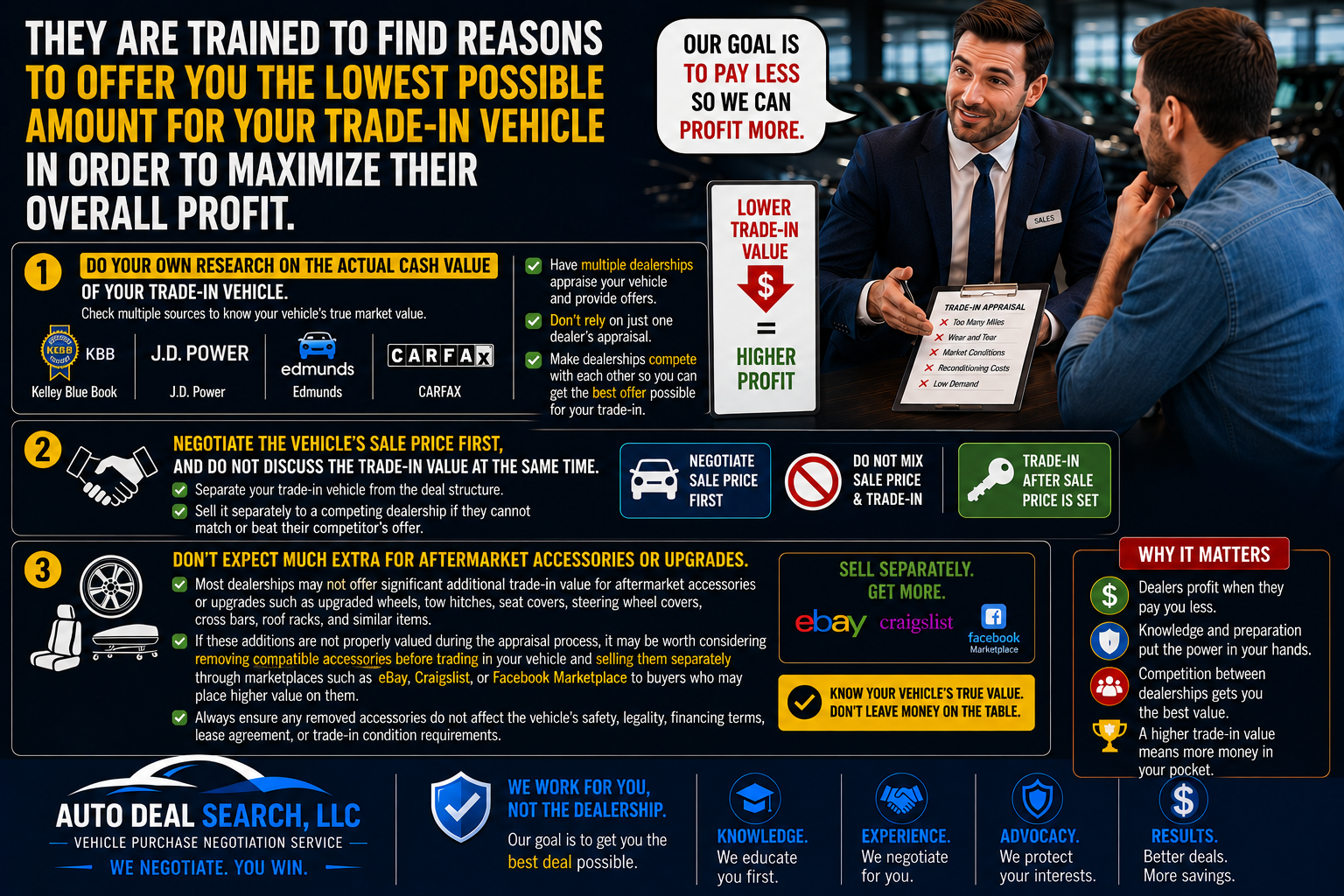
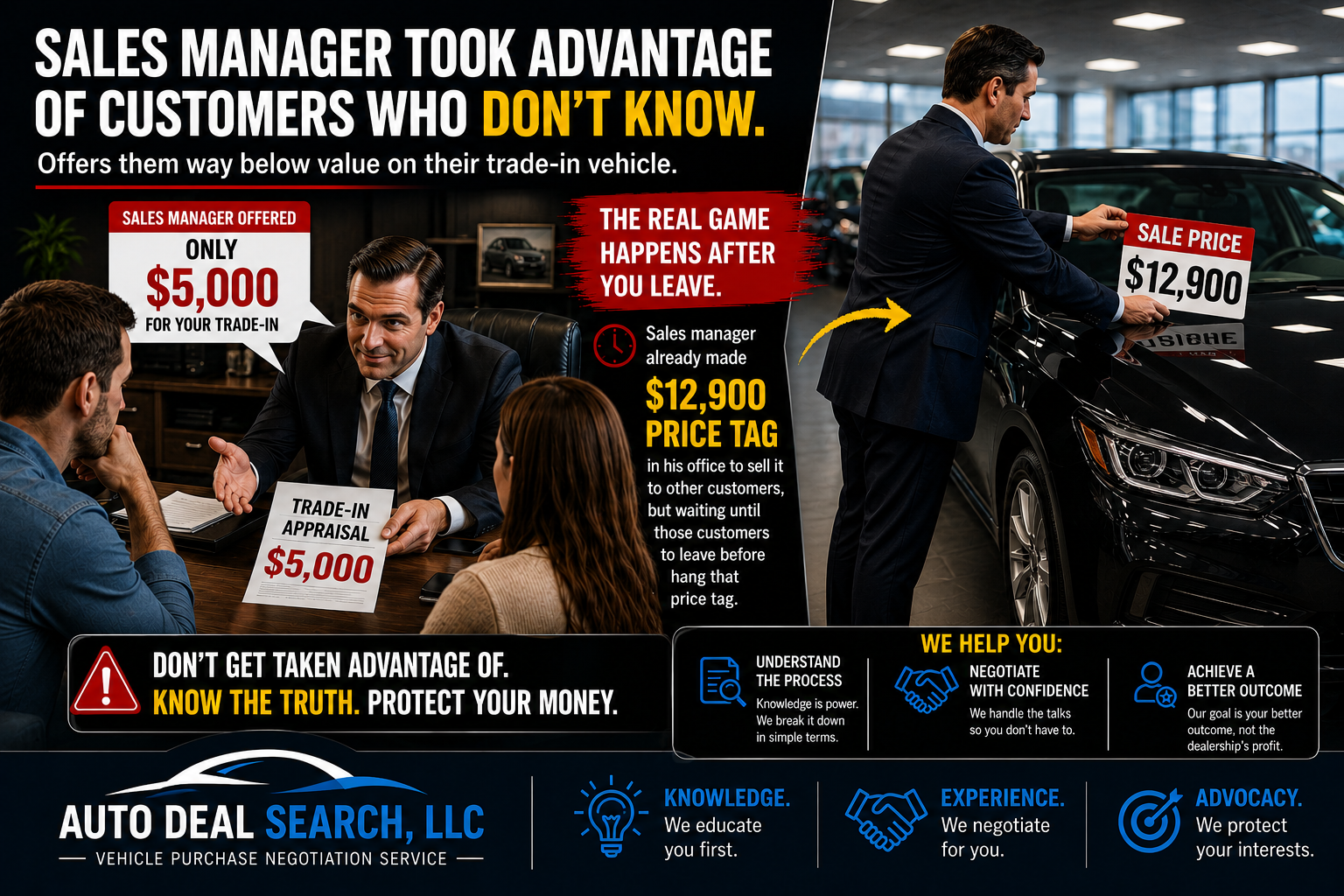
*They are trained to find reasons to offer you the lowest possible amount for your trade-in vehicle to maximize their overall profit.
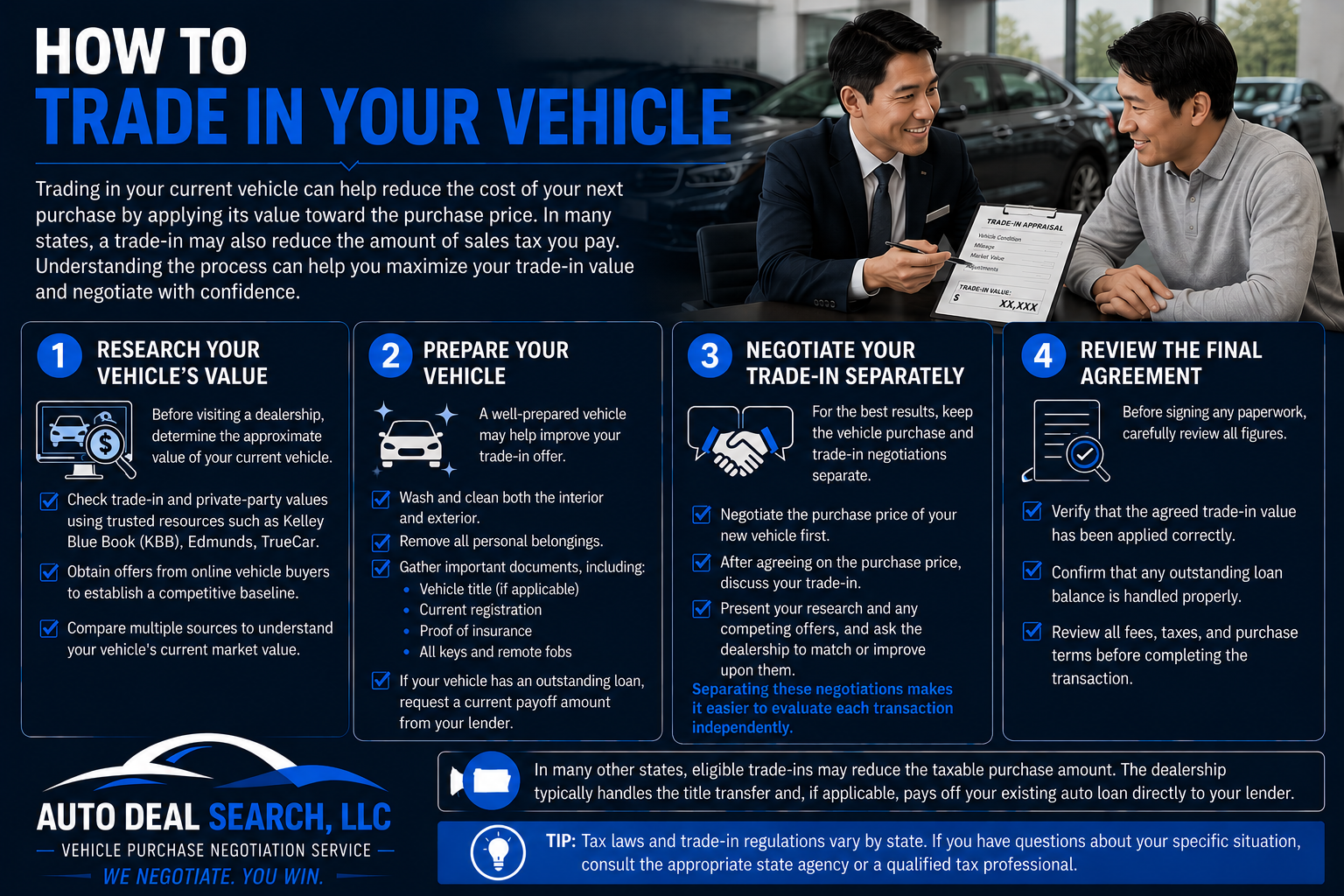
Trading in your current vehicle can help reduce the cost of your next purchase by applying its value toward the purchase price. In many states, a trade-in may also reduce the amount of sales tax you pay. Understanding the process can help you maximize your trade-in value and negotiate with confidence.
-Do your own research on the actual cash value of your trade-in vehicle by checking multiple sources, such as KBB(Kelley Blue Book),
J.D. Power(NADA), Edmunds, and CARFAX. Also, have multiple dealerships appraise your vehicle and provide offers. Don’t rely on just one
dealer’s appraisal. Make dealerships compete with each other so you can get the best offer possible for your trade-in.
-Prepare Your Vehicle. A well-prepared vehicle may help improve your trade-in offer.
--Wash and clean both the interior and exterior.
--Remove all personal belongings.
--Gather important documents, including : Vehicle title (if applicable), Current registration, Proof of insurance, All keys and remote fobs
-Negotiate the vehicle’s sale price first, and do not discuss the trade-in value at the same time. Separate your trade-in vehicle from the deal structure,
and sell it separately to a competing dealership if they cannot match or beat their competitor’s offer.
-Most dealerships may not offer significant additional trade-in value for aftermarket accessories or upgrades such as upgraded wheels,
tow hitches, seat covers, steering wheel covers, cross bars, roof racks, and similar items. If these additions are not properly valued during
the appraisal process, it may be worth considering removing compatible accessories before trading in your vehicle and selling them separately
through marketplaces such as eBay, Craigslist, or Facebook Marketplace to buyers who may place a higher value on them.
Always ensure any removed accessories do not affect the vehicle’s safety, legality, financing terms, lease agreement, or trade-in condition requirements.
-The dealership typically handles the title transfer and, if applicable, pays off your existing auto loan directly to your lender.
Tip : Tax laws and trade-in regulations vary by state. If you have questions about your specific situation, consult the appropriate state agency or a qualified tax professional.
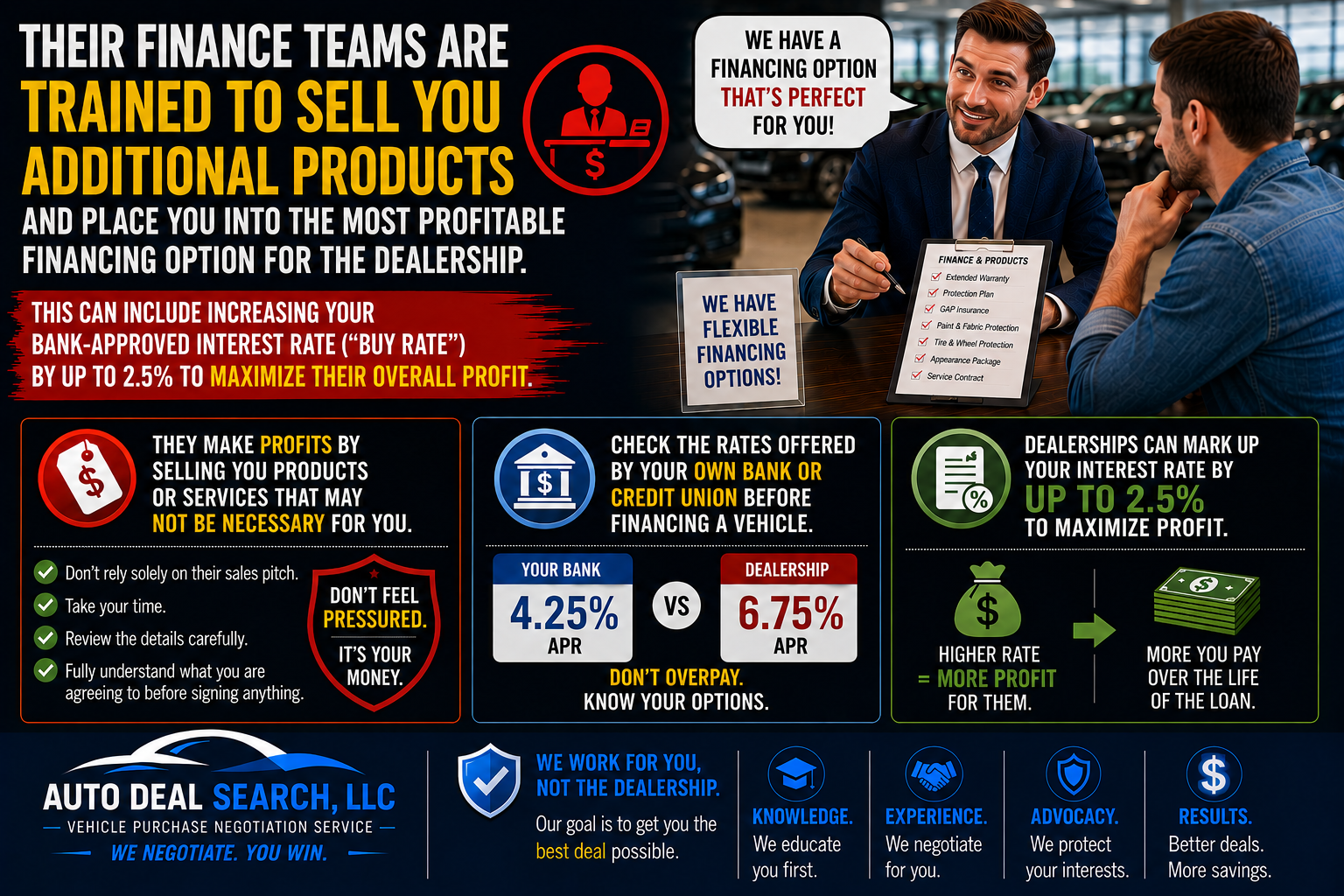
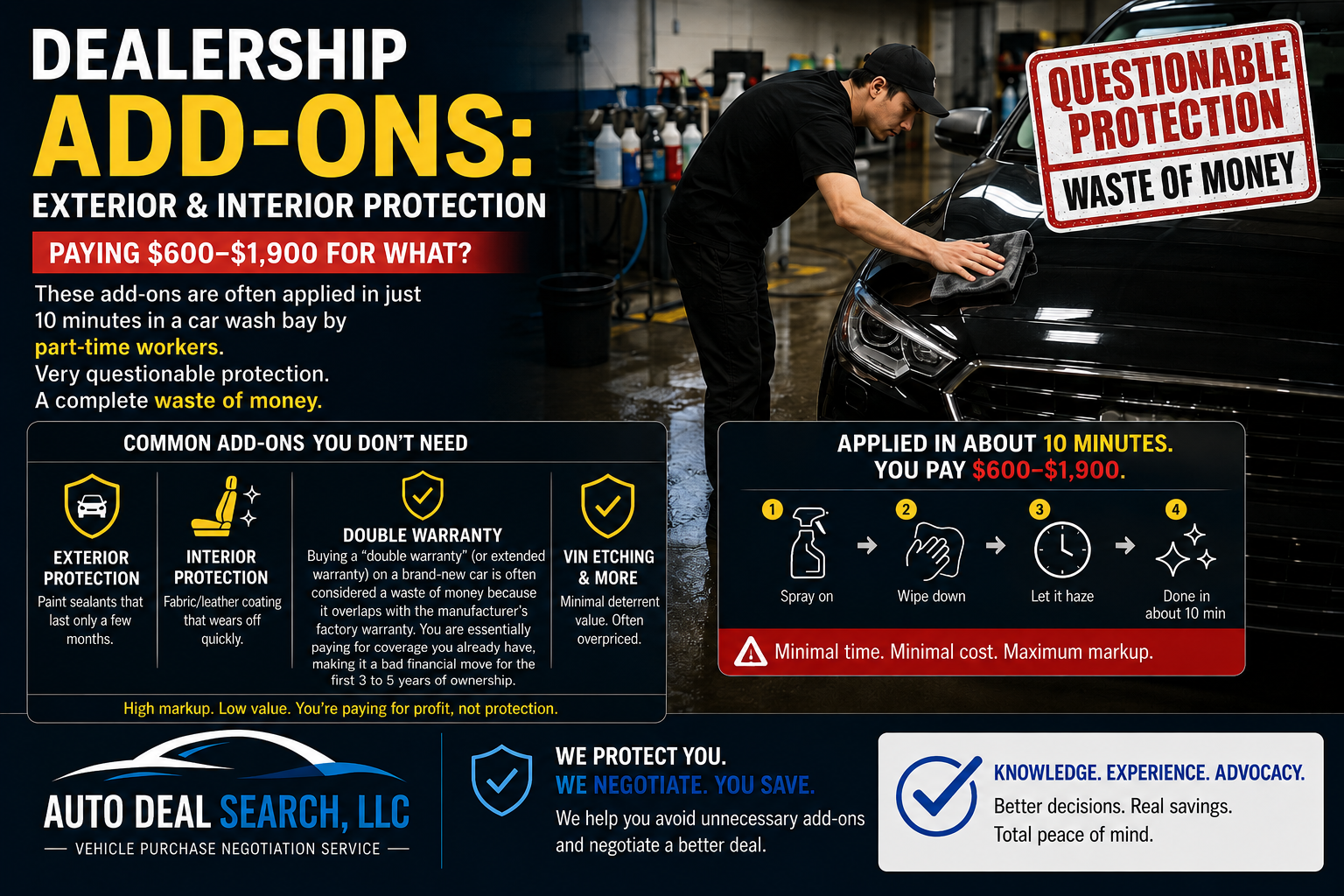
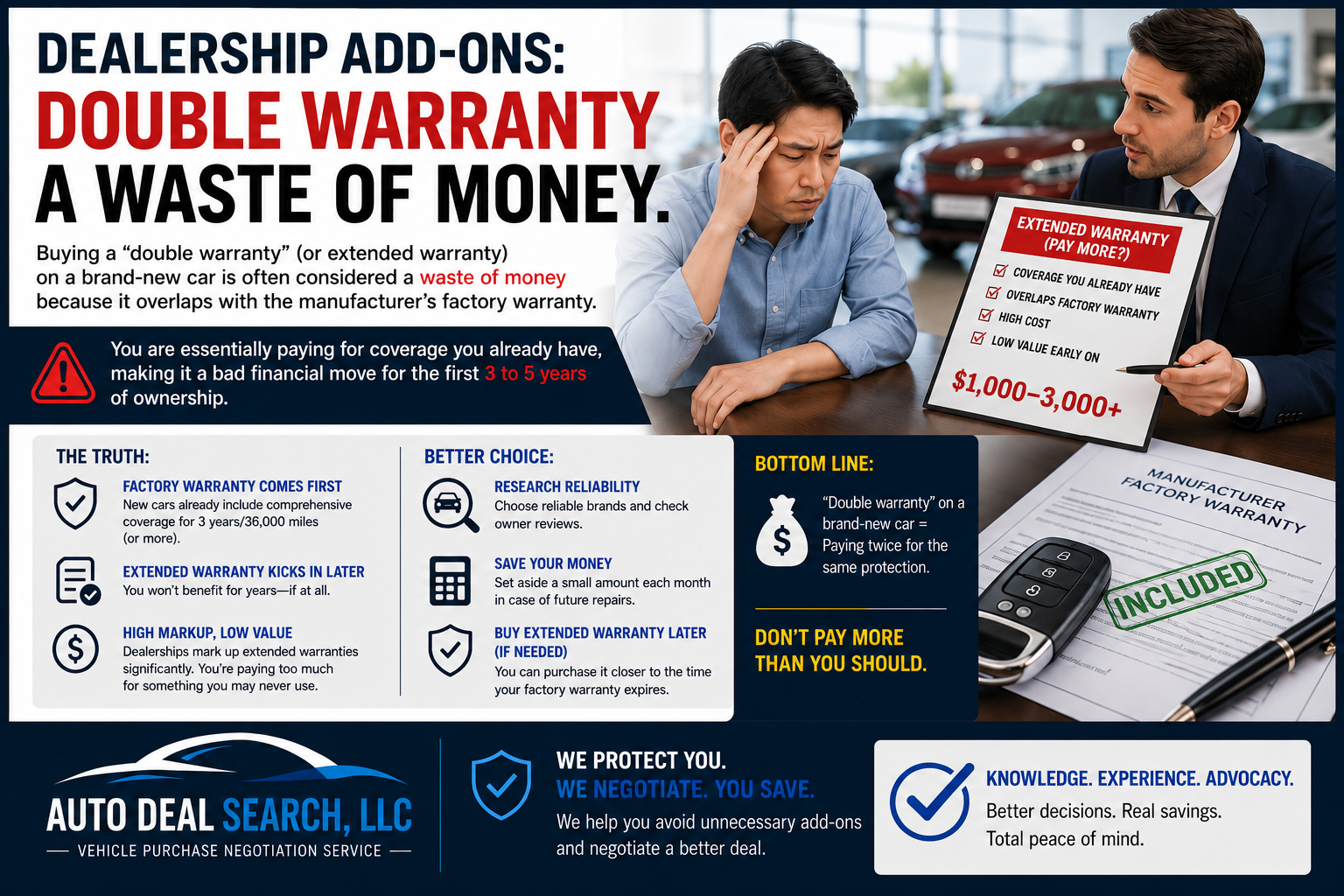
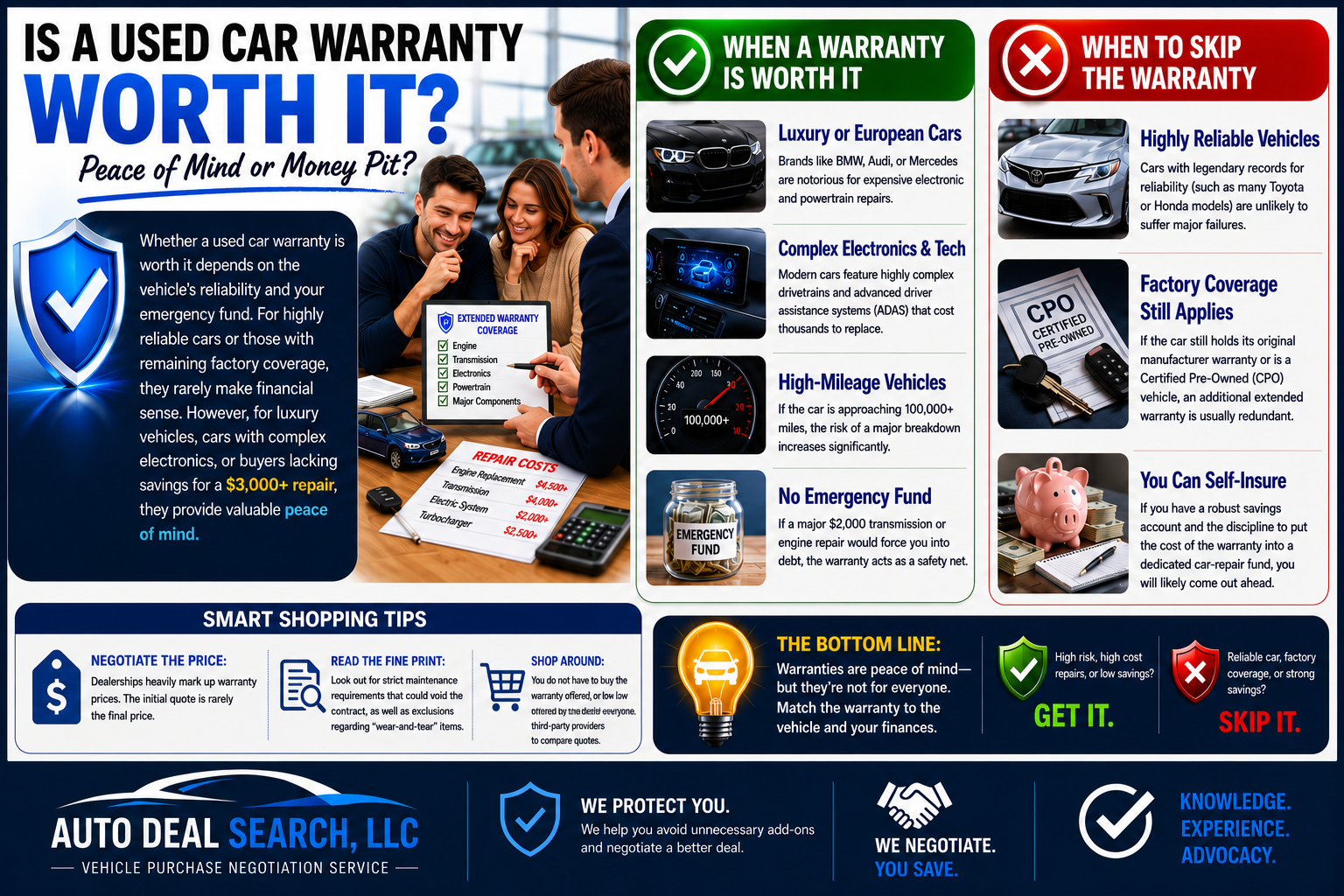
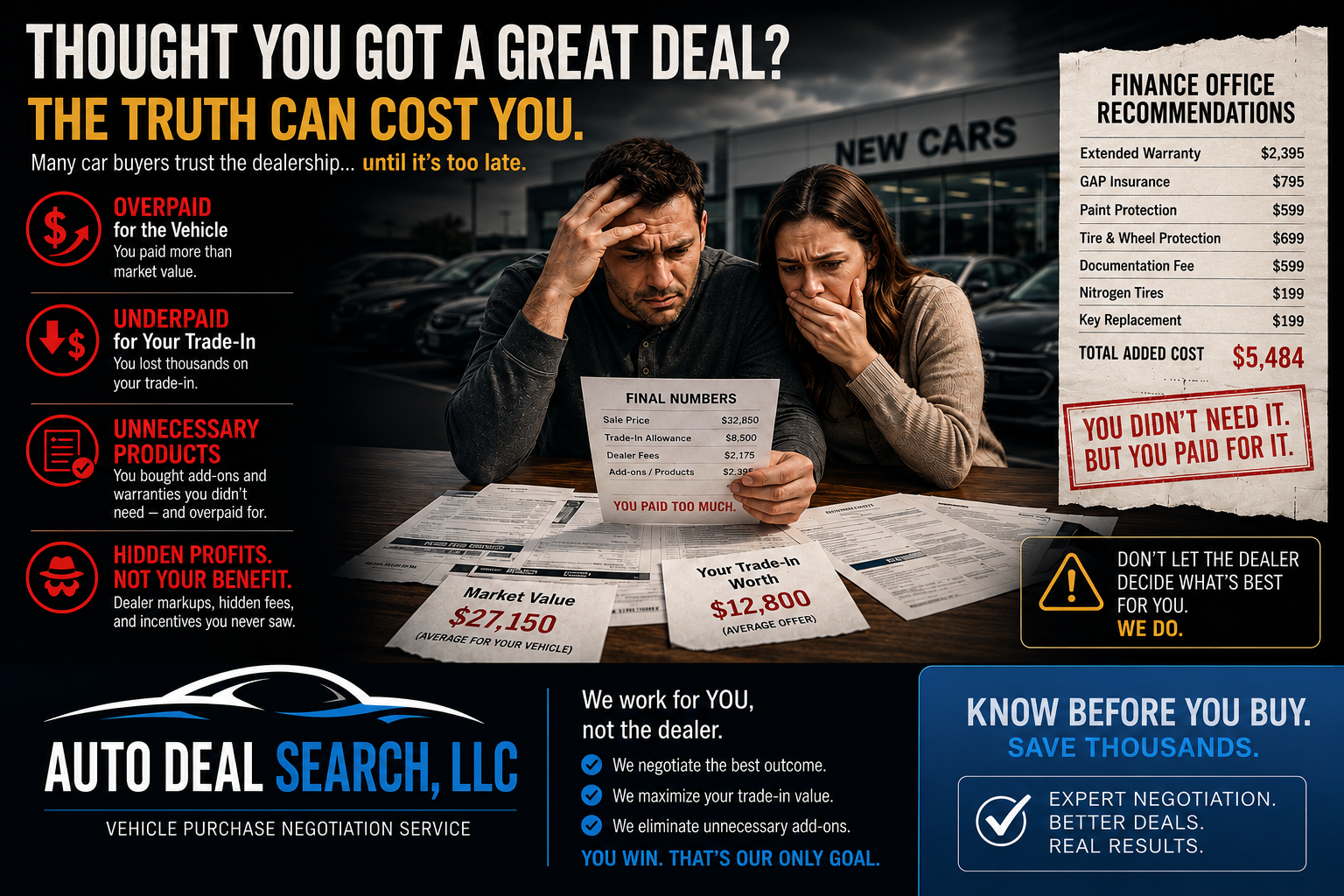
*Their finance teams are trained to sell you additional products — such as warranties, protection plans, and accessories —
and place you into the most profitable financing option for the dealership. This can include increasing your bank-approved
interest rate (“buy rate”) by up to 2.5% to maximize their overall profit.
-They make profits by selling you products or services that may not be necessary for you. Don’t rely solely on their sales pitch — take your time,
review the details carefully, and fully understand what you are agreeing to before signing anything.
-Check the rates offered by your own bank or credit union before financing a vehicle. Don’t automatically accept a higher interest rate from the
dealership and end up paying more than necessary.
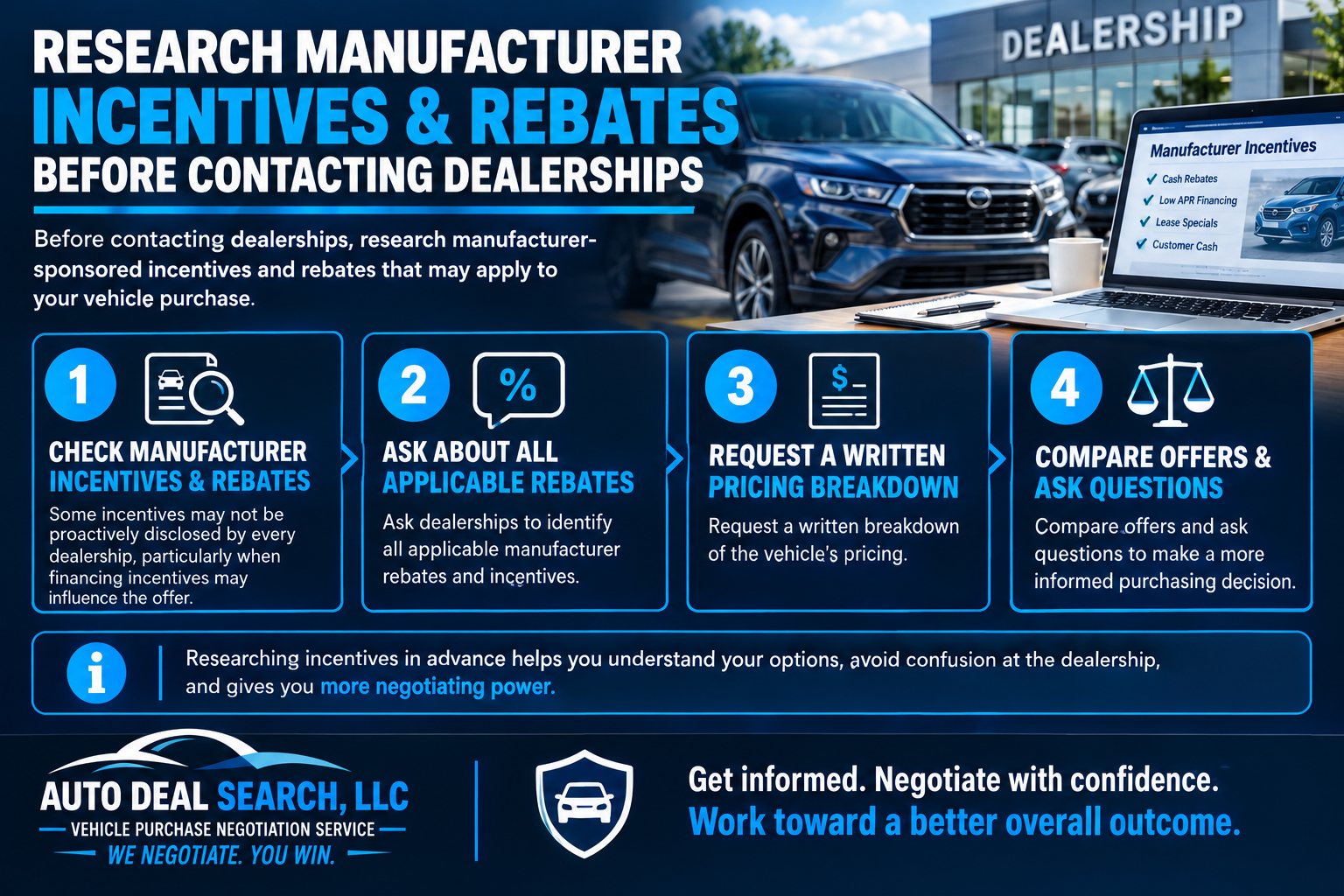
*Research Manufacturer Incentives Before Contacting Dealerships
-Before contacting dealerships, research all available manufacturer-sponsored incentives and rebates that may apply to your vehicle purchase.
Some incentives may not be proactively disclosed by every dealership, particularly when the dealership has a financial incentive to encourage customers to
finance through its preferred lending institutions. Understanding which incentives are available can help you ask the right questions, compare offers more effectively, and make a more informed purchasing decision. Always ask the dealership to identify all applicable manufacturer rebates and incentives and
provide a written breakdown of the vehicle's pricing.
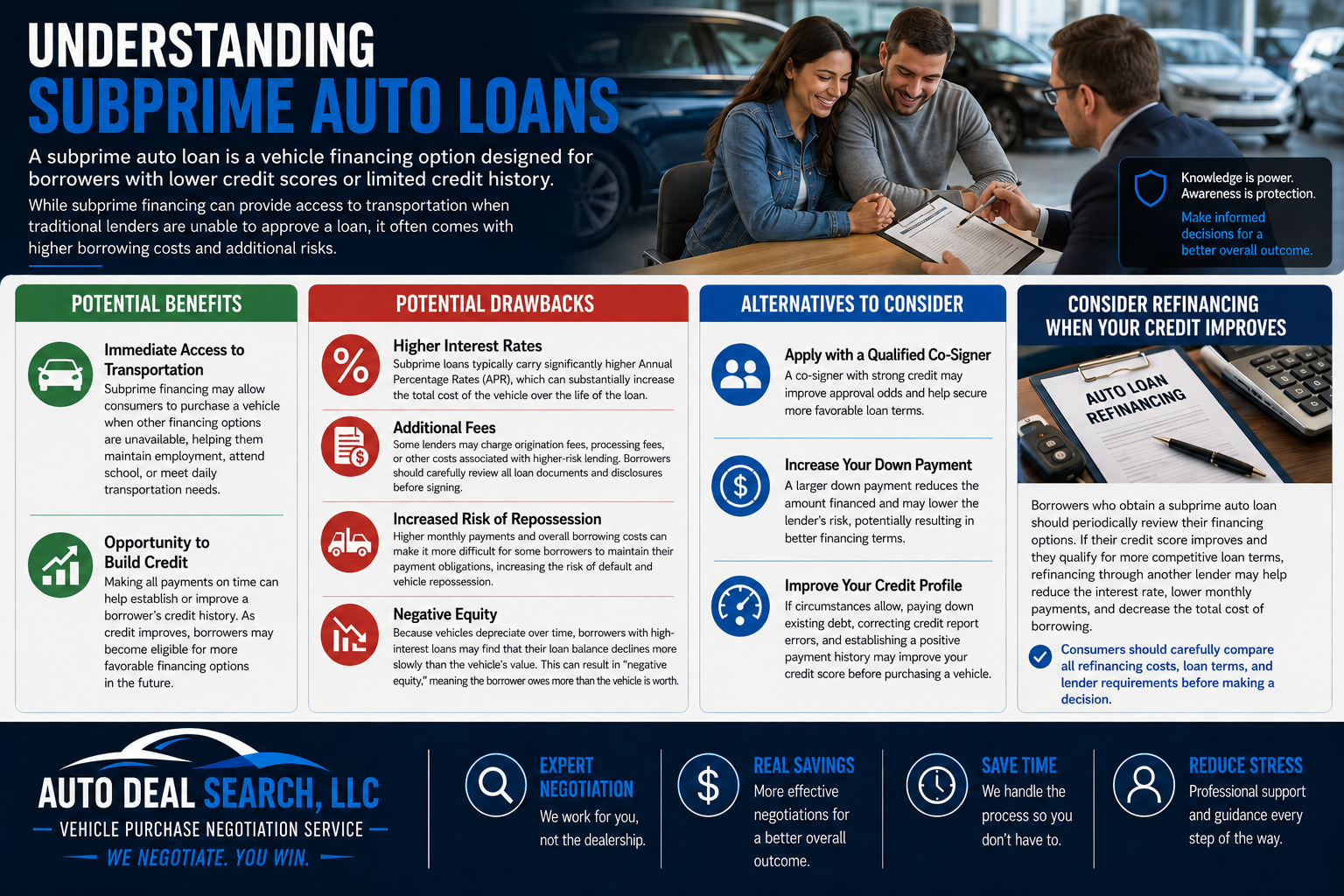
*Understanding Subprime Auto Loans
-A subprime auto loan is a vehicle financing option designed for borrowers with lower credit scores or limited credit history. While subprime financing can provide access to transportation when traditional lenders are unable to approve a loan, it often comes with higher borrowing costs and additional risks.
Potential Benefits
-Immediate Access to Transportation
Subprime financing may allow consumers to purchase a vehicle when other financing options are unavailable, helping them maintain employment,
attend school, or meet daily transportation needs.
-Opportunity to Build Credit
Making all payments on time can help establish or improve a borrower's credit history. As credit improves, borrowers may become eligible for more
favorable financing options in the future.
Potential Drawbacks
-Higher Interest Rates
Subprime loans typically carry significantly higher Annual Percentage Rates (APR), which can substantially increase the total cost of the vehicle over
the life of the loan.
-Additional Fees
Some lenders may charge origination fees, processing fees, or other costs associated with higher-risk lending. Borrowers should carefully review all loan
documents and disclosures before signing.
-Increased Risk of Repossession
Higher monthly payments and overall borrowing costs can make it more difficult for some borrowers to maintain their payment obligations, increasing
the risk of default and vehicle repossession.
-Negative Equity
Because vehicles depreciate over time, borrowers with high-interest loans may find that their loan balance declines more slowly than the vehicle's value.
This can result in "negative equity," meaning the borrower owes more than the vehicle is worth.
Alternatives to Consider
-Apply with a Qualified Co-Signer
A co-signer with strong credit may improve approval odds and help secure more favorable loan terms.
-Increase Your Down Payment
A larger down payment reduces the amount financed and may lower the lender's risk, potentially resulting in better financing terms.
-Improve Your Credit Profile
If circumstances allow, paying down existing debt, correcting credit report errors, and establishing a positive payment history may improve your credit score before purchasing a vehicle.
Consider Refinancing When Your Credit Improves
-Borrowers who obtain a subprime auto loan should periodically review their financing options. If their credit score improves and they qualify for more
competitive loan terms, refinancing through another lender may help reduce the interest rate, lower monthly payments, and decrease the total cost of
borrowing. Consumers should carefully compare all refinancing costs, loan terms, and lender requirements before making a decision.
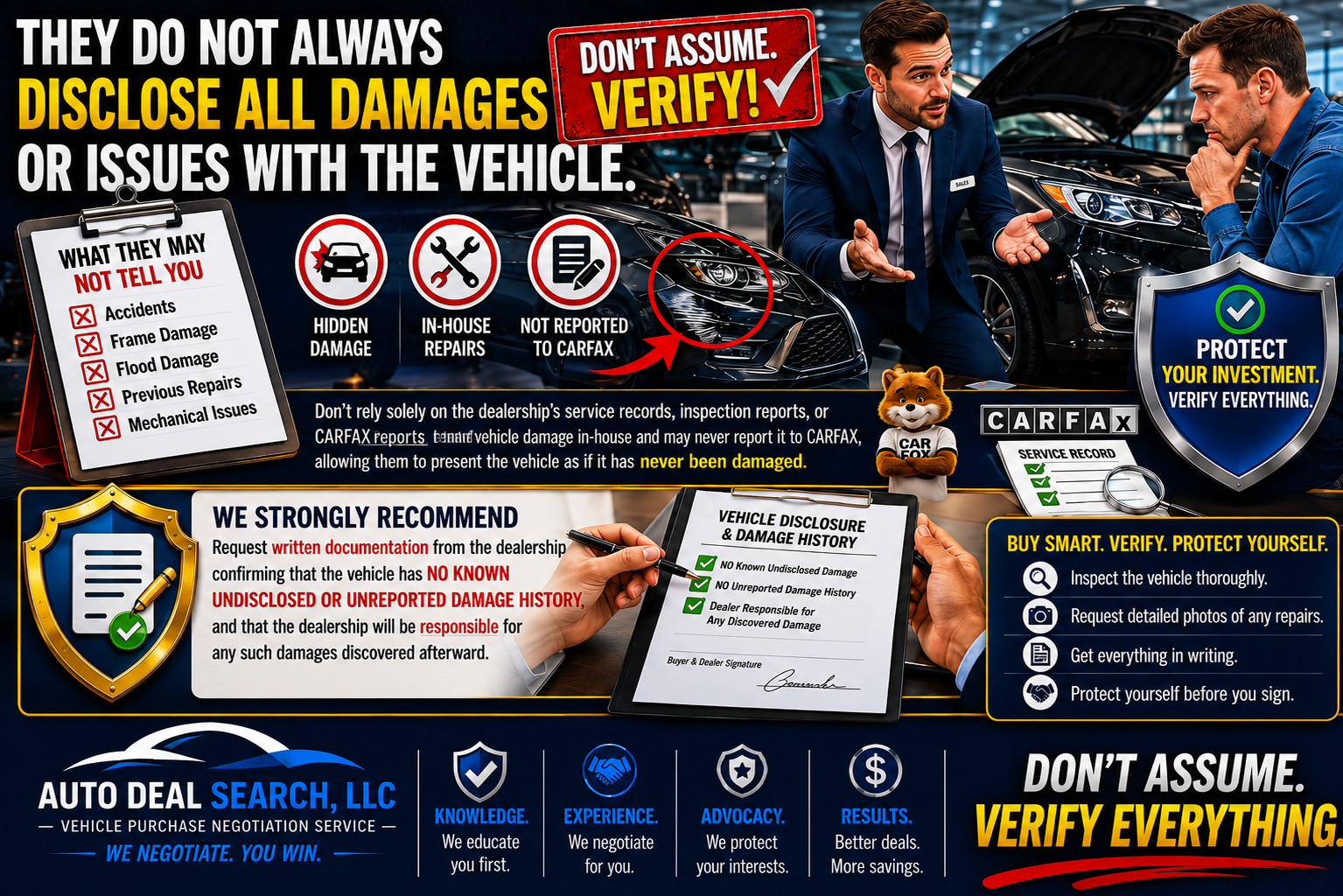
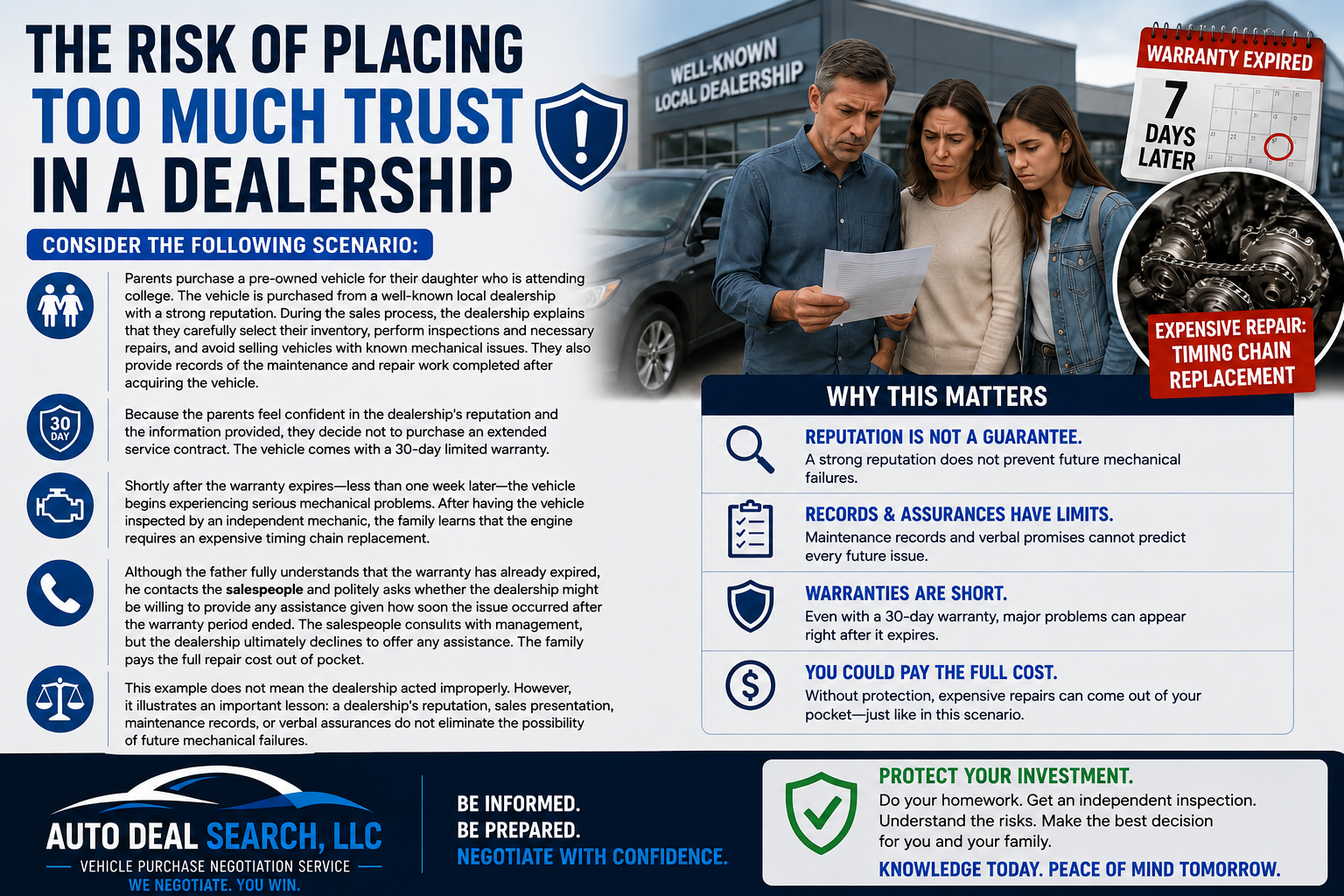
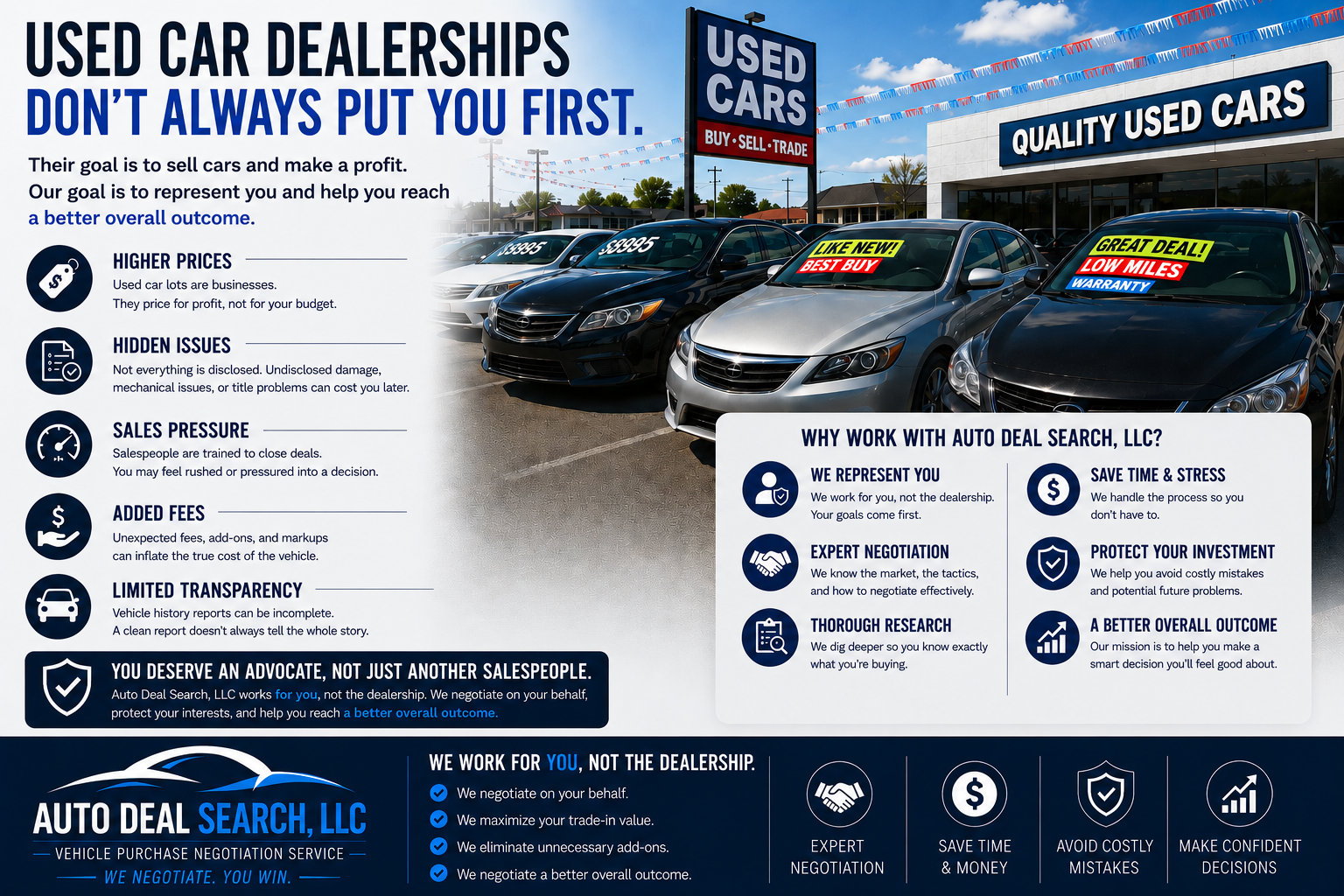
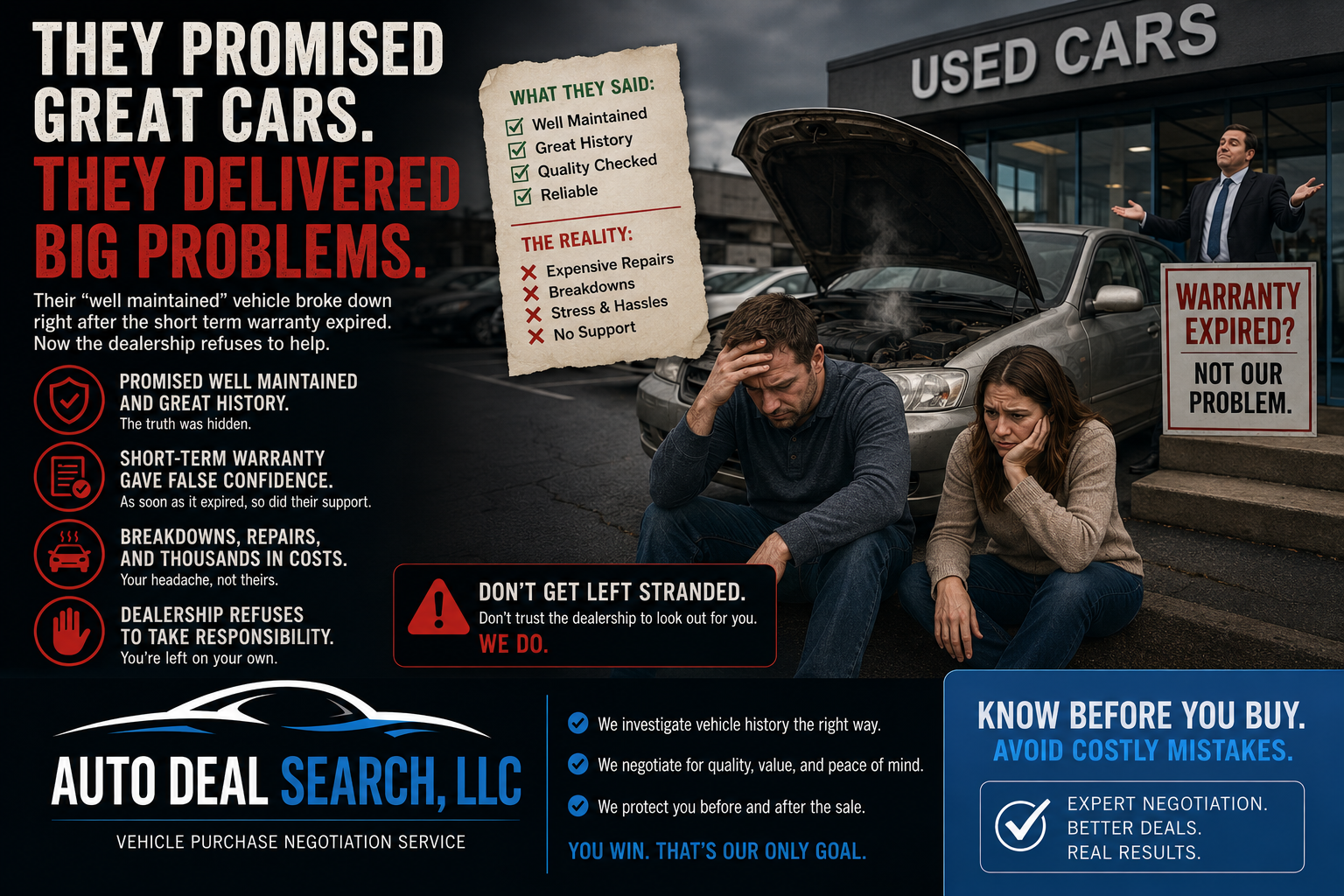
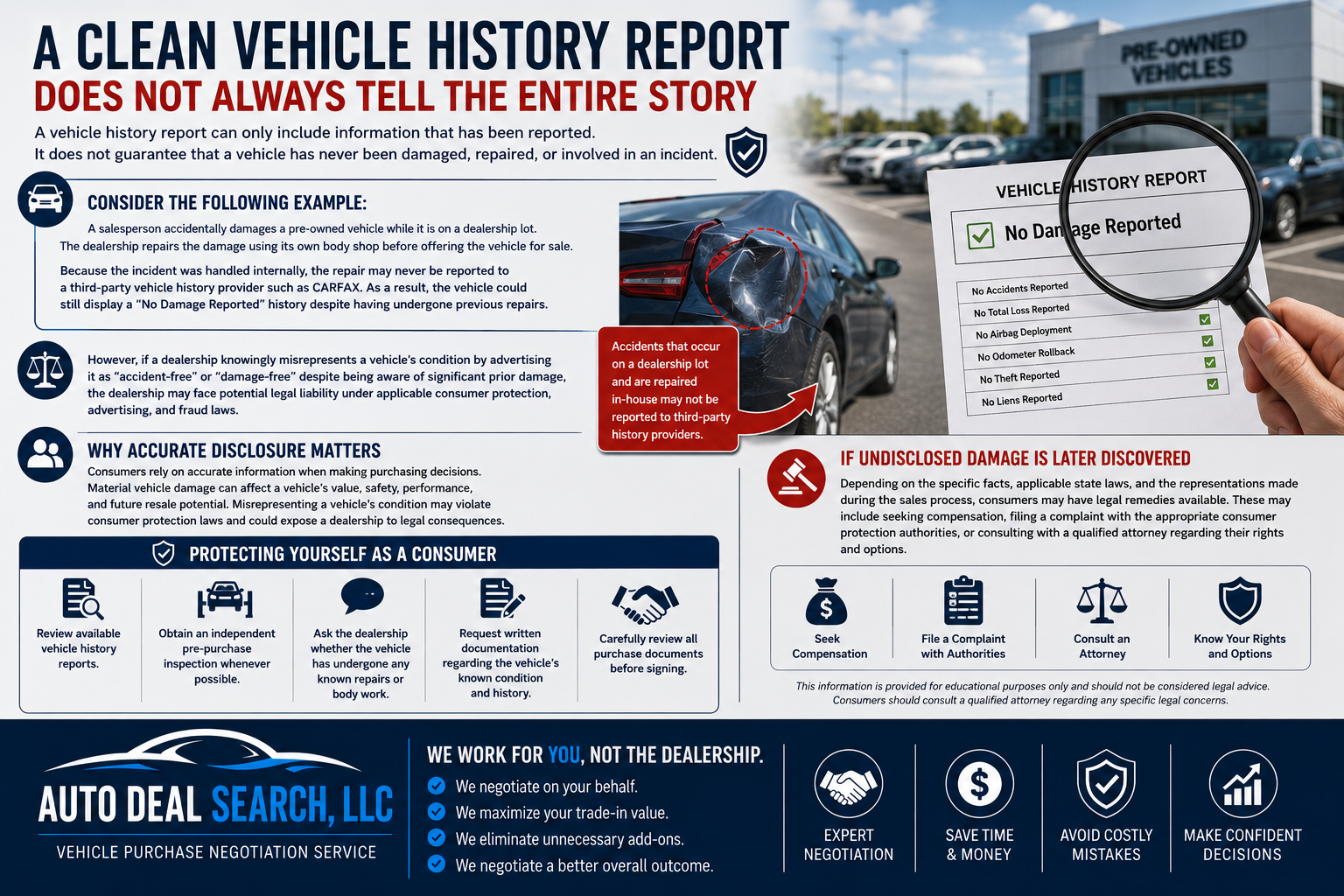
*They do not always disclose all damages or issues with the vehicle.
-Don’t rely solely on the dealership’s service records, inspection reports, or CARFAX report. Many dealerships repair vehicle damage in-house and may never report it to CARFAX, allowing them to present the vehicle as if it has never been damaged. We strongly recommend requesting written documentation from the dealership confirming that the vehicle has no known undisclosed or unreported damage history, and that the dealership will be responsible for any such damages discovered afterward.
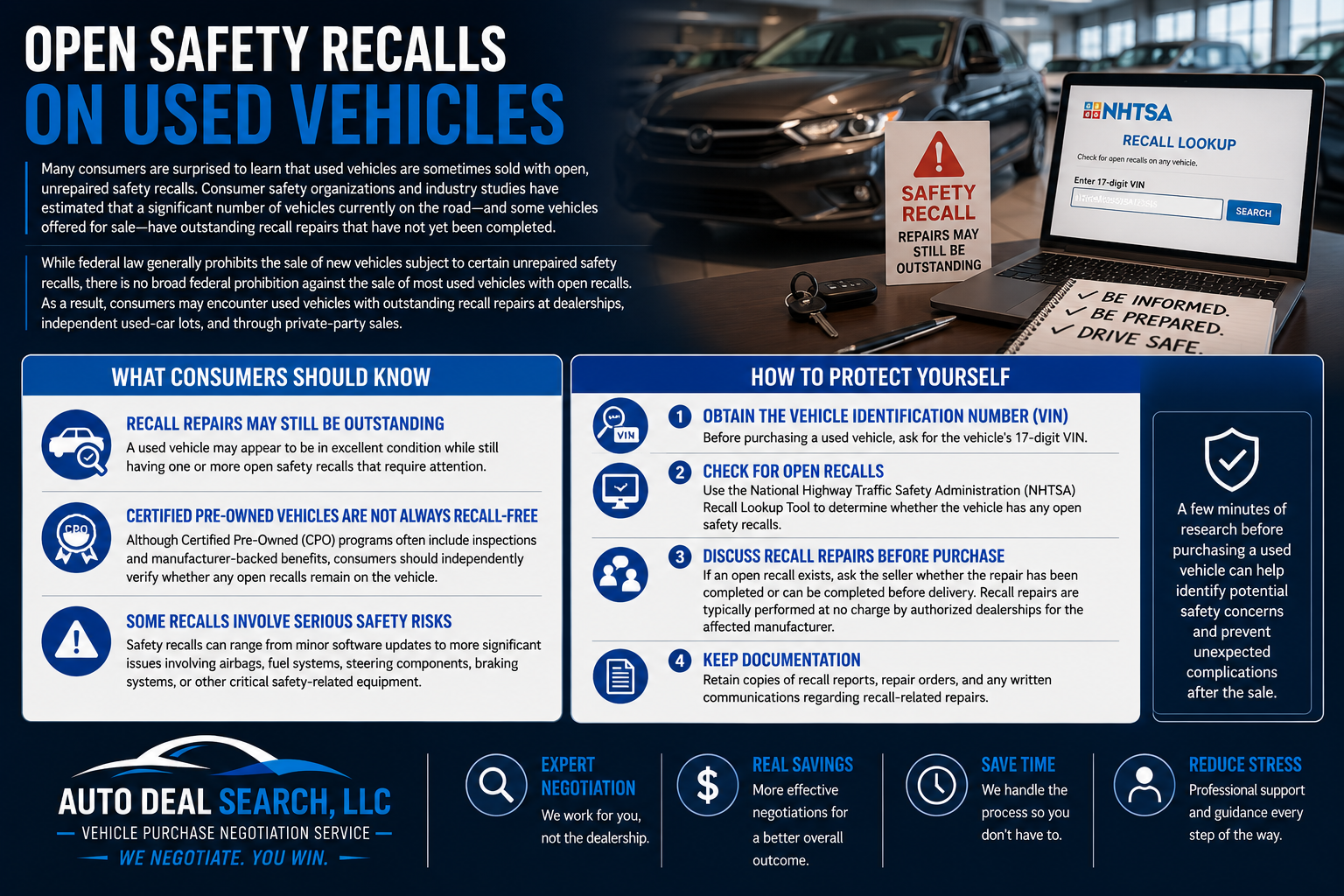
*Check used car recalls before buying. Open Safety Recalls on Used Vehicles.
-Many consumers are surprised to learn that used vehicles are sometimes sold with open, unrepaired safety recalls. Consumer safety organizations and
industry studies have estimated that a significant number of vehicles currently on the road—and some vehicles offered for sale—have outstanding recall
repairs that have not yet been completed. While federal law generally prohibits the sale of new vehicles subject to certain unrepaired safety recalls, there is no broad federal prohibition against the sale of most used vehicles with open recalls. As a result, consumers may encounter used vehicles with outstanding
recall repairs at dealerships, independent used-car lots, and through private-party sales.
What Consumers Should Know
-Recall Repairs May Still Be Outstanding
A used vehicle may appear to be in excellent condition while still having one or more open safety recalls that require attention.
-Certified Pre-Owned Vehicles Are Not Always Recall-Free
Although Certified Pre-Owned (CPO) programs often include inspections and manufacturer-backed benefits, consumers should independently verify whether any open recalls remain on the vehicle.
-Some Recalls Involve Serious Safety Risks
Safety recalls can range from minor software updates to more significant issues involving airbags, fuel systems, steering components, braking systems, or other critical safety-related equipment.
How to Protect Yourself
-Obtain the Vehicle Identification Number (VIN)
Before purchasing a used vehicle, ask for the vehicle's 17-digit VIN.
-Check for Open Recalls
Use the National Highway Traffic Safety Administration (NHTSA) Recall Lookup Tool to determine whether the vehicle has any open safety recalls.
-Discuss Recall Repairs Before Purchase
If an open recall exists, ask the seller whether the repair has been completed or can be completed before delivery. Recall repairs are typically performed at no charge by authorized dealerships for the affected manufacturer.
-Keep Documentation
Retain copies of recall reports, repair orders, and any written communications regarding recall-related repairs.
A few minutes of research before purchasing a used vehicle can help identify potential safety concerns and prevent unexpected complications after the sale.
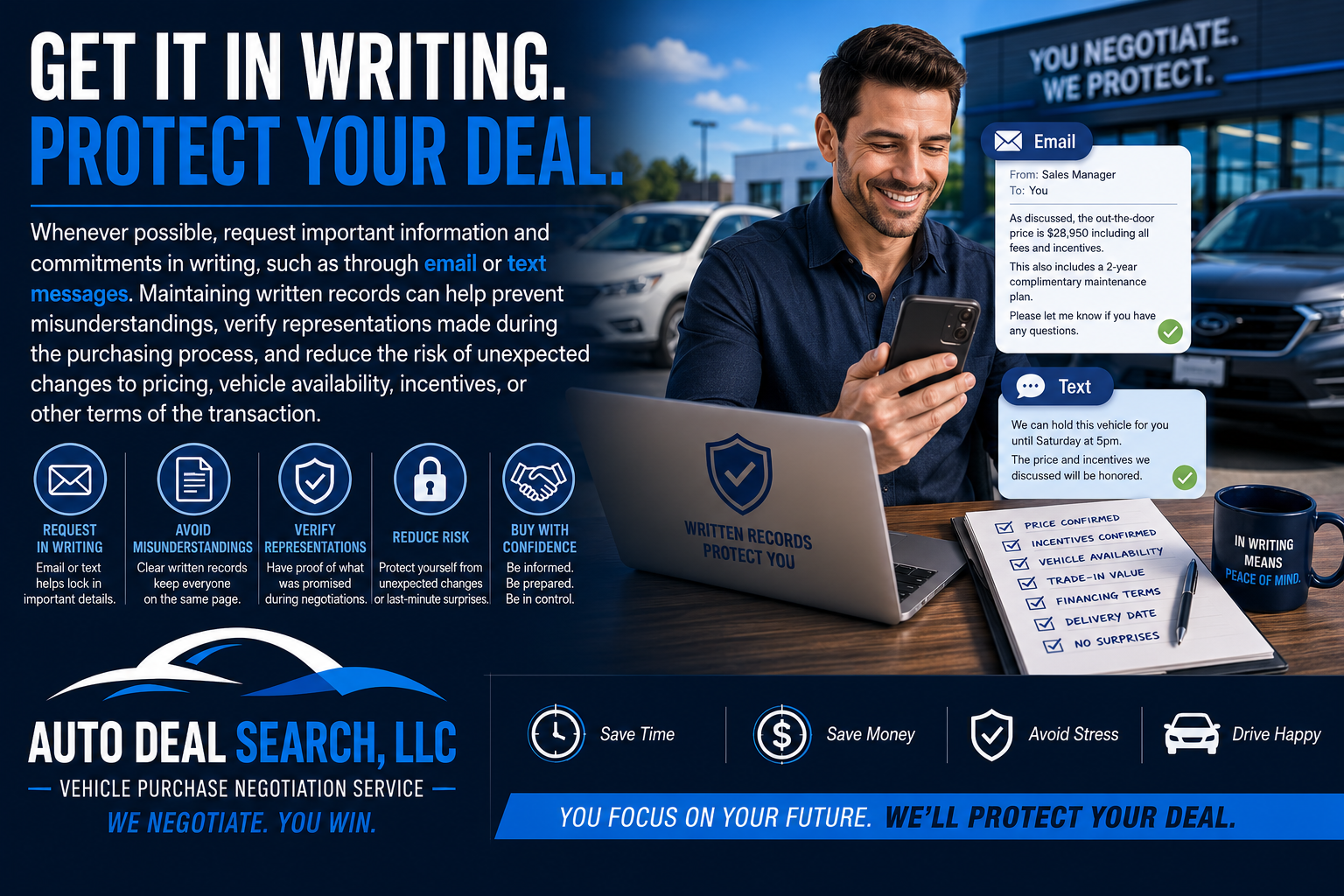
*No written record means no reliable proof.
-Whenever possible, request important information and commitments in writing, such as through email or text messages. Maintaining written records can help prevent misunderstandings, verify representations made during the purchasing process, and reduce the risk of unexpected changes to pricing, vehicle availability, incentives, or other terms of the transaction.
*Don't forget to explore your "Refinancing options".
-If your credit profile improves after purchasing the vehicle, you may wish to explore refinancing options with banks, credit unions, or other lenders to
determine whether you qualify for a lower interest rate.
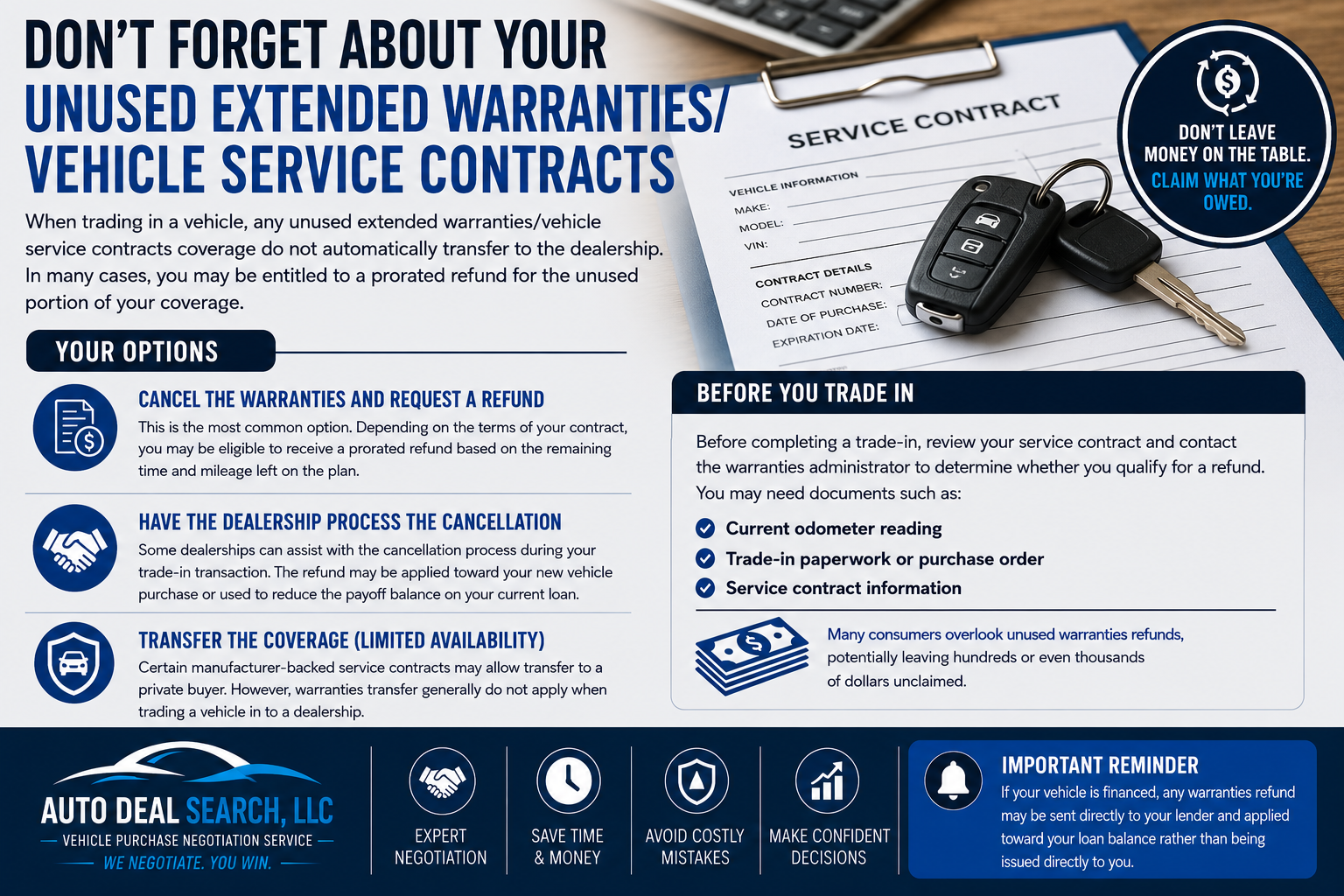
*Don't forget about your unused "Extended warranties/Vehicle service contracts".
-When trading in a vehicle, any unused extended warranties/vehicle service contracts coverage do not automatically transfer to the dealership. In many cases, you may be entitled to a prorated refund for the unused portion of your coverage.
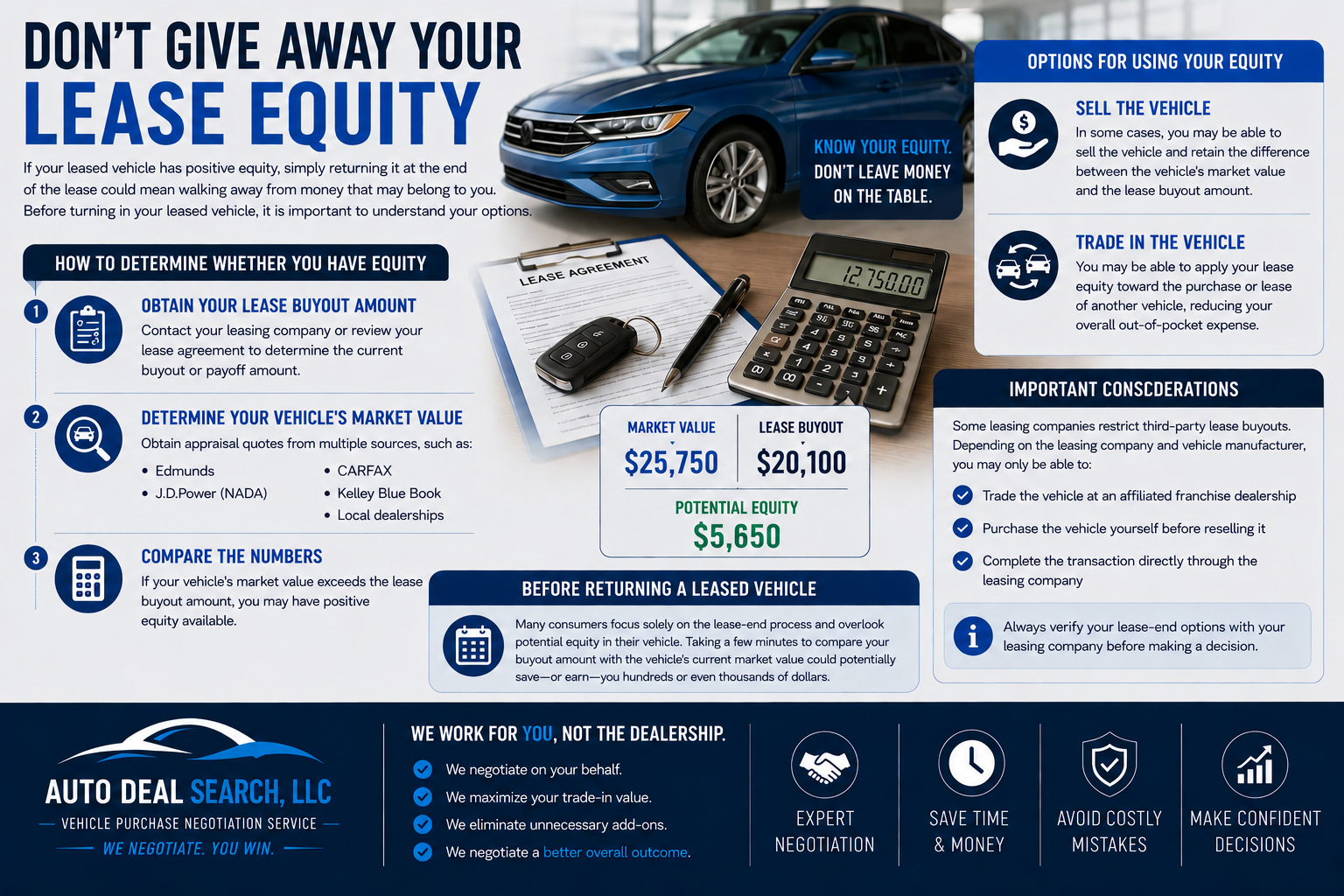
*Don't give away your "Lease equity".
-If your leased vehicle has positive equity, simply returning it at the end of the lease could mean walking away from money that may belong to you. Before turning in your leased vehicle, it is important to understand your options.
1. Find your buyout quote : Locate the exact "payoff" or "buyout" amount in your contract or by calling your leasing company. 2. Determine the market value : Get instant appraisal quotes from sites like KBB(Kelley Blue Book), J.D. Power(NADA), Edmunds, CARFAX or
local dealerships to see what your car is worth.
3. Compare numbers : If your appraisal offers are higher than your buyout quote, you have positive equity.
4. Cash out or trade in :
-Sell to a third-party dealer : Take your car to dealerships that buy leases. If you can sell it to them, they pay off the leasing company and cut you a check for the difference.
-Trade it in : Use the equity as a down payment on a new vehicle.
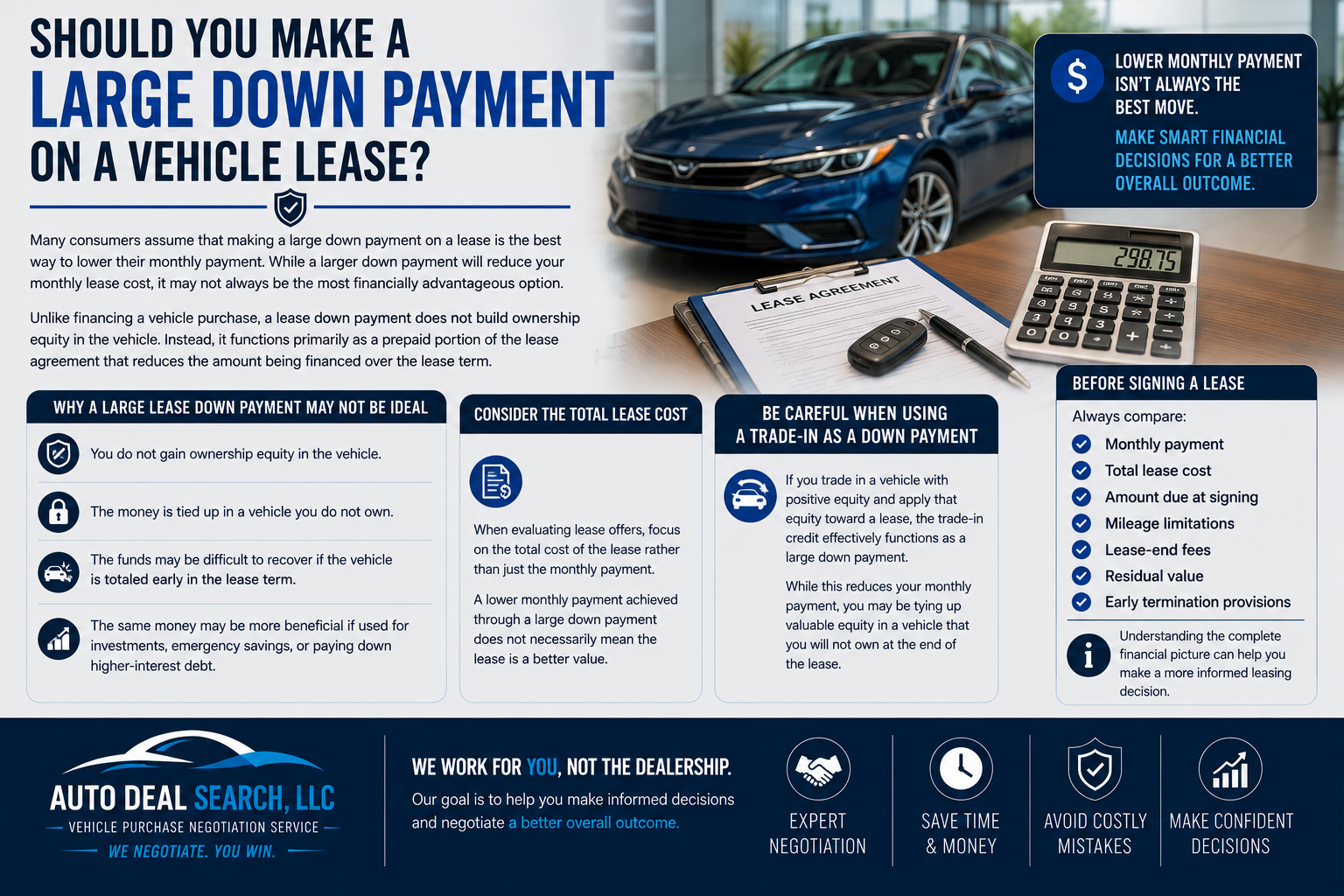
*Should You Make a Large Down Payment on a Vehicle Lease?
-Many consumers assume that making a large down payment on a lease is the best way to lower their monthly payment. While a larger down payment will
reduce your monthly lease cost, it may not always be the most financially advantageous option.
Unlike financing a vehicle purchase, a lease down payment does not build ownership equity in the vehicle. Instead, it functions primarily as a prepaid
portion of the lease agreement that reduces the amount being financed over the lease term.
Why a Large Lease Down Payment May Not Be Ideal
-You do not gain ownership equity in the vehicle.
-The money is tied up in a vehicle you do not own.
-The funds may be difficult to recover if the vehicle is totaled early in the lease term.
-The same money may be more beneficial if used for investments, emergency savings, or paying down higher-interest debt.
Consider the Total Lease Cost
-When evaluating lease offers, focus on the total cost of the lease rather than just the monthly payment. A lower monthly payment achieved through a large down payment does not necessarily mean the lease is a better value.
Be Careful When Using a Trade-In as a Down Payment
-If you trade in a vehicle with positive equity and apply that equity toward a lease, the trade-in credit effectively functions as a large down payment. While
this reduces your monthly payment, you may be tying up valuable equity in a vehicle that you will not own at the end of the lease.
A Better Approach
-Many financial professionals recommend considering lease offers with little or no money due at signing whenever possible. This allows you to retain control of your cash while still benefiting from the lower monthly payments that leasing can provide.
Before Signing a Lease
Always compare :
-Monthly payment
-Total lease cost
-Amount due at signing
-Mileage limitations
-Lease-end fees
-Residual value
-Early termination provisions
Understanding the complete financial picture can help you make a more informed leasing decision.
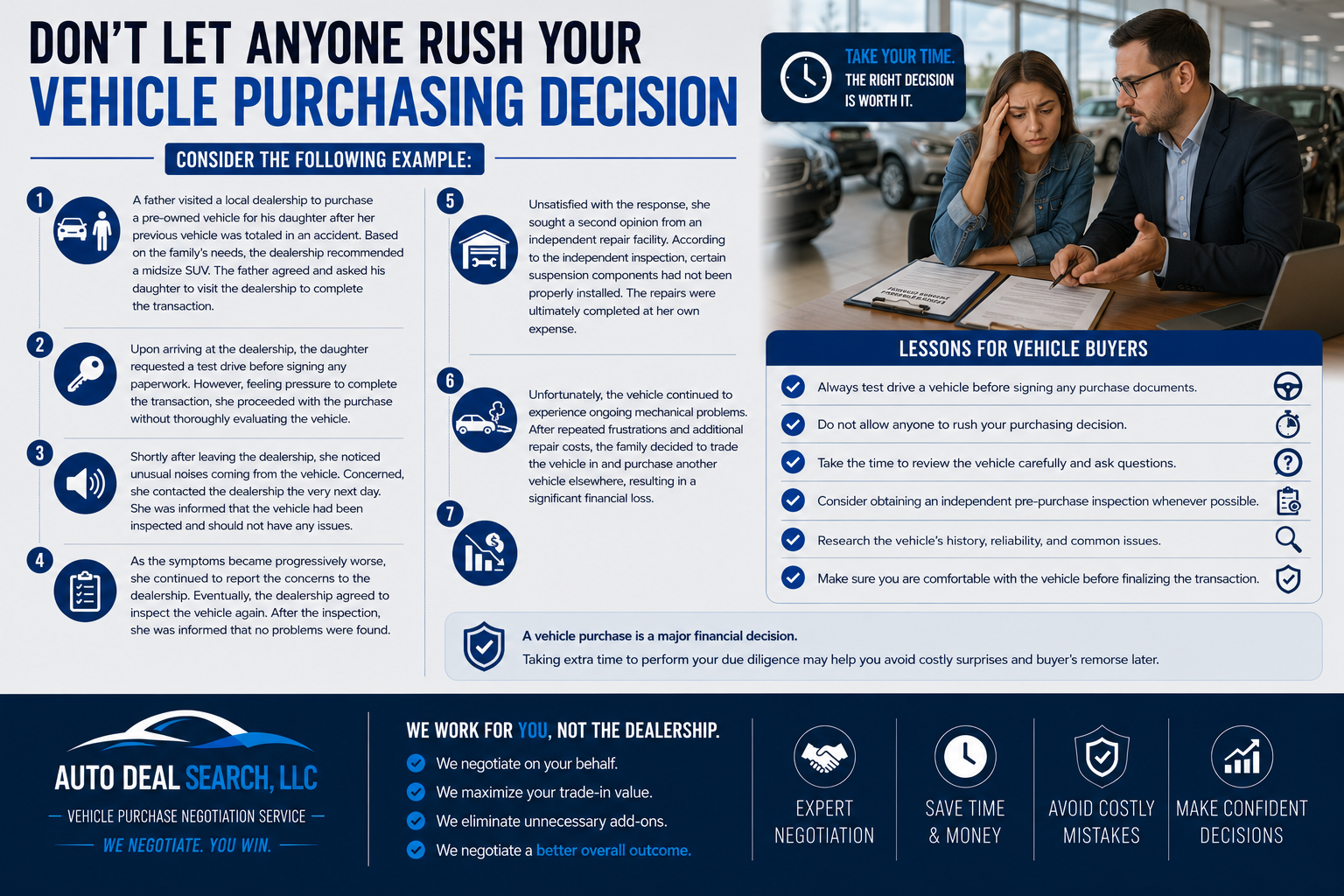
*Don't Let Anyone Rush Your Vehicle Purchasing Decision
-Always test drive a vehicle before signing any purchase documents.
-Take the time to review the vehicle carefully and ask questions.
-Consider obtaining an independent pre-purchase inspection whenever possible.
-Research the vehicle's history, reliability, and common issues.
-Make sure you are comfortable with the vehicle before finalizing the transaction.
A vehicle purchase is a major financial decision. Taking extra time to perform your due diligence may help you avoid costly surprises and buyer's remorse later. Don't hesitate to leave the dealership if you feel pressured or rushed into making a decision. A reputable seller should allow you sufficient time to
evaluate the vehicle, review the terms, and make an informed purchasing decision. If you feel uncomfortable, it may be a sign that you should slow down
and carefully reconsider the transaction before proceeding.
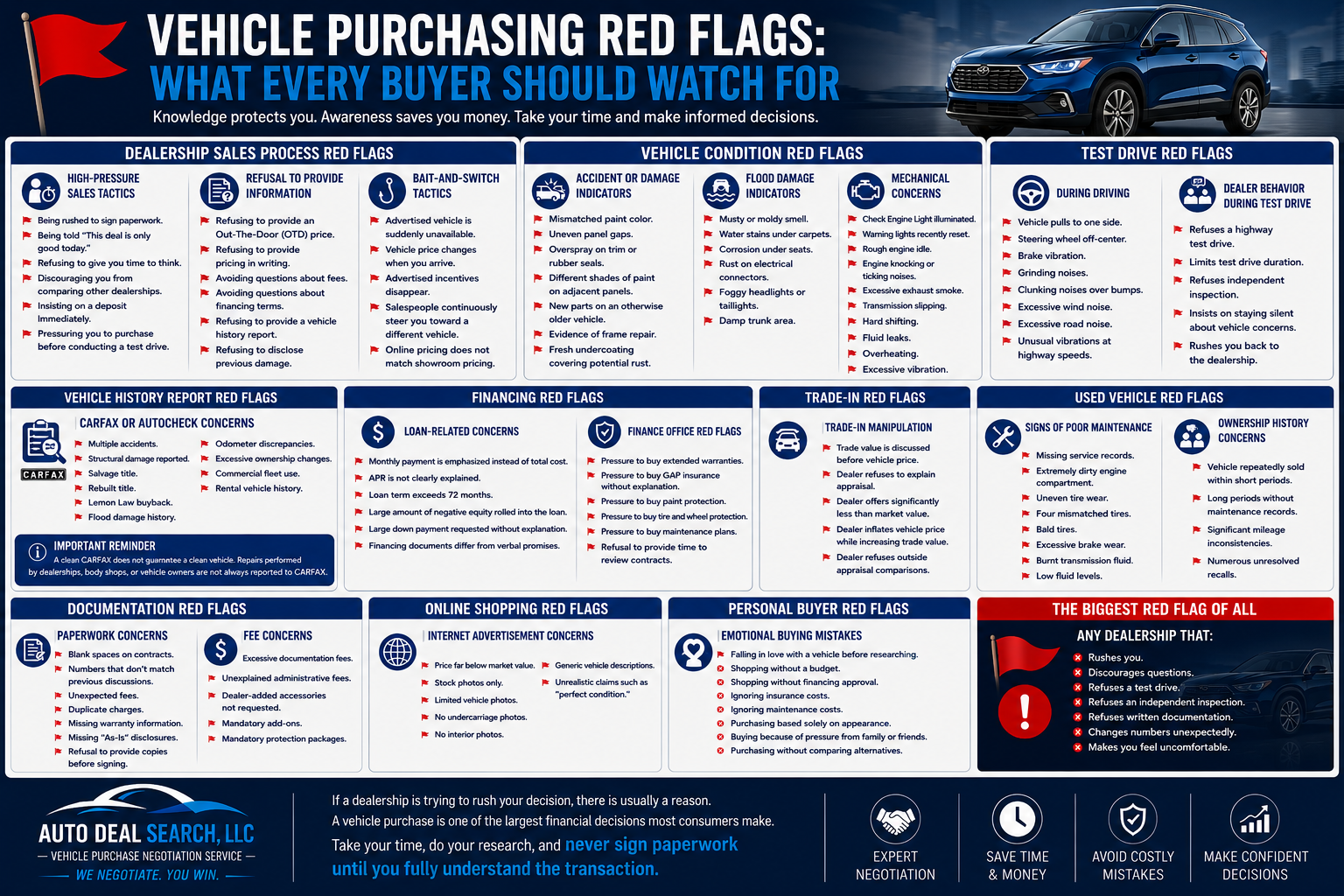
*Vehicle Purchasing Red Flags : What Every Buyer Should Watch For
Dealership Sales Process Red Flags
-High-Pressure Sales Tactics
--Being rushed to sign paperwork.
--Being told "This deal is only good today."
--Refusing to give you time to think.
--Discouraging you from comparing other dealerships.
--Insisting on a deposit immediately.
--Pressuring you to purchase before conducting a test drive.
-Refusal to Provide Information
--Refusing to provide an Out-The-Door (OTD) price.
--Refusing to provide pricing in writing.
--Avoiding questions about fees.
--Avoiding questions about financing terms.
--Refusing to provide a vehicle history report.
--Refusing to disclose previous damage.
-Bait-and-Switch Tactics
--Advertised vehicle is suddenly unavailable.
--Vehicle price changes when you arrive.
--Advertised incentives disappear.
--Salespeople continuously steer you toward a different vehicle.
--Online pricing does not match showroom pricing.
Vehicle Condition Red Flags
-Accident or Damage Indicators
--Mismatched paint color.
--Uneven panel gaps.
--Overspray on trim or rubber seals.
--Different shades of paint on adjacent panels.
--New parts on an otherwise older vehicle.
--Evidence of frame repair.
--Fresh undercoating covering potential rust.
-Flood Damage Indicators
--Musty or moldy smell.
--Water stains under carpets.
--Corrosion under seats.
--Rust on electrical connectors.
--Foggy headlights or taillights.
--Damp trunk area.
-Mechanical Concerns
--Check Engine Light illuminated.
--Warning lights recently reset.
--Rough engine idle.
--Engine knocking or ticking noises.
--Excessive exhaust smoke.
--Transmission slipping.
--Hard shifting.
--Fluid leaks.
--Overheating.
--Excessive vibration.
Test Drive Red Flags
-During Driving
--Vehicle pulls to one side.
--Steering wheel off-center.
--Brake vibration.
--Grinding noises.
--Clunking noises over bumps.
--Excessive wind noise.
--Excessive road noise.
--Unusual vibrations at highway speeds.
-Dealer Behavior During Test Drive
--Refuses a highway test drive.
--Limits test drive duration.
--Refuses independent inspection.
--Insists on staying silent about vehicle concerns.
--Rushes you back to the dealership.
Vehicle History Report Red Flags
-CARFAX or AutoCheck Concerns
--Multiple accidents.
--Structural damage reported.
--Salvage title.
--Rebuilt title.
--Lemon Law buyback.
--Flood damage history.
--Odometer discrepancies.
--Excessive ownership changes.
--Commercial fleet use.
--Rental vehicle history.
-Important Reminder
A clean CARFAX does not guarantee a clean vehicle. Repairs performed by dealerships, body shops, or vehicle owners are not always reported to CARFAX.
Financing Red Flags
-Loan-Related Concerns
--Monthly payment is emphasized instead of total cost.
--APR is not clearly explained.
--Loan term exceeds 72 months.
--Large amount of negative equity rolled into the loan.
--Large down payment requested without explanation.
--Financing documents differ from verbal promises.
-Finance Office Red Flags
--Pressure to buy extended warranties.
--Pressure to buy GAP insurance without explanation.
--Pressure to buy paint protection.
--Pressure to buy tire and wheel protection.
--Pressure to buy maintenance plans.
--Refusal to provide time to review contracts.
Trade-In Red Flags
-Trade-In Manipulation
--Trade value is discussed before vehicle price.
--Dealer refuses to explain appraisal.
--Dealer offers significantly less than market value.
--Dealer inflates vehicle price while increasing trade value.
--Dealer refuses outside appraisal comparisons.
Used Vehicle Red Flags
-Signs of Poor Maintenance
--Missing service records.
--Extremely dirty engine compartment.
--Uneven tire wear.
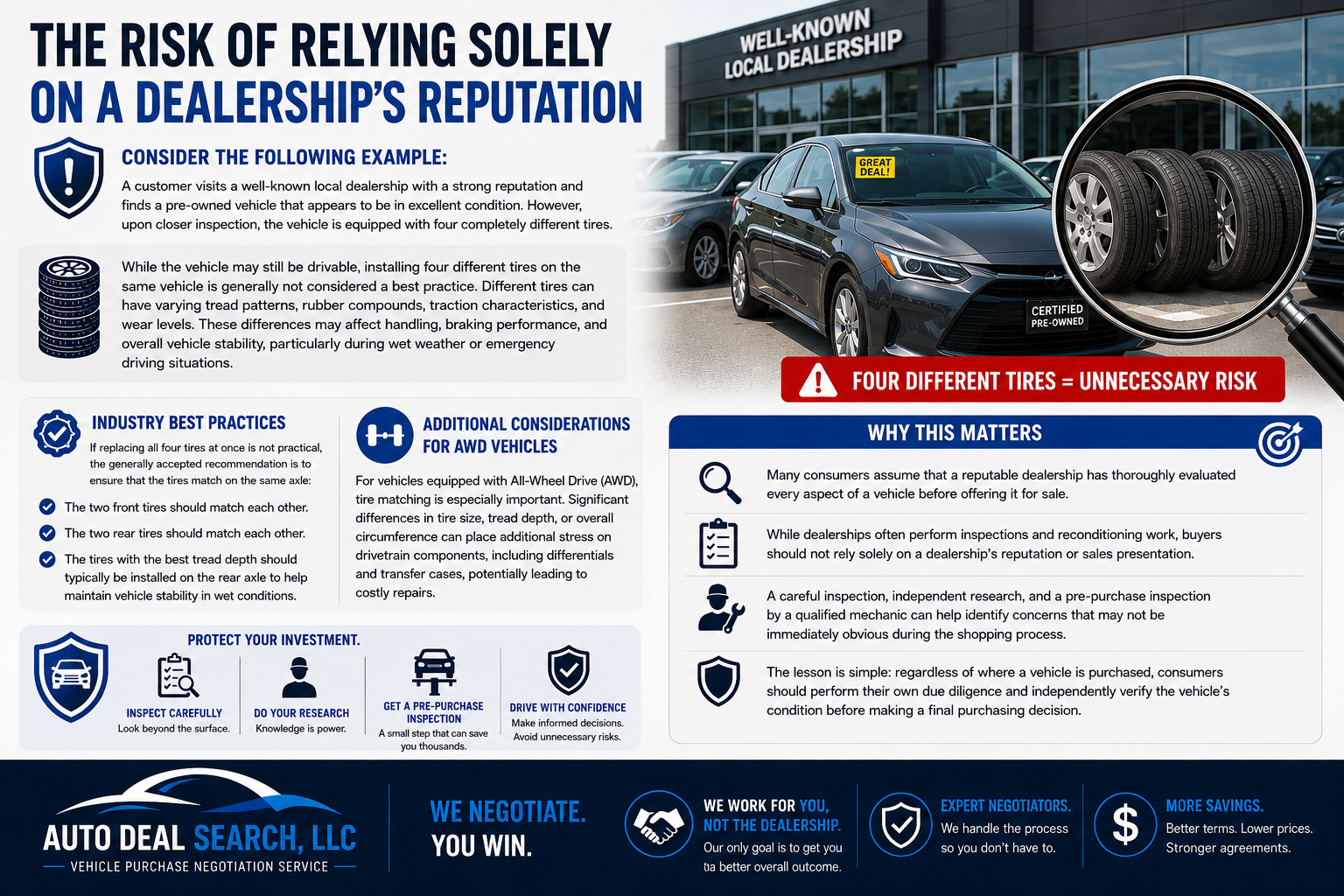
--Four mismatched tires.
--Bald tires.
--Excessive brake wear.
--Burnt transmission fluid.
--Low fluid levels.
-Ownership History Concerns
--Vehicle repeatedly sold within short periods.
--Long periods without maintenance records.
--Significant mileage inconsistencies.
--Numerous unresolved recalls.
Documentation Red Flags
-Paperwork Concerns
--Blank spaces on contracts.
--Numbers that don't match previous discussions.
--Unexpected fees.
--Duplicate charges.
--Missing warranty information.
--Missing "As-Is" disclosures.
--Refusal to provide copies before signing.
-Fee Concerns
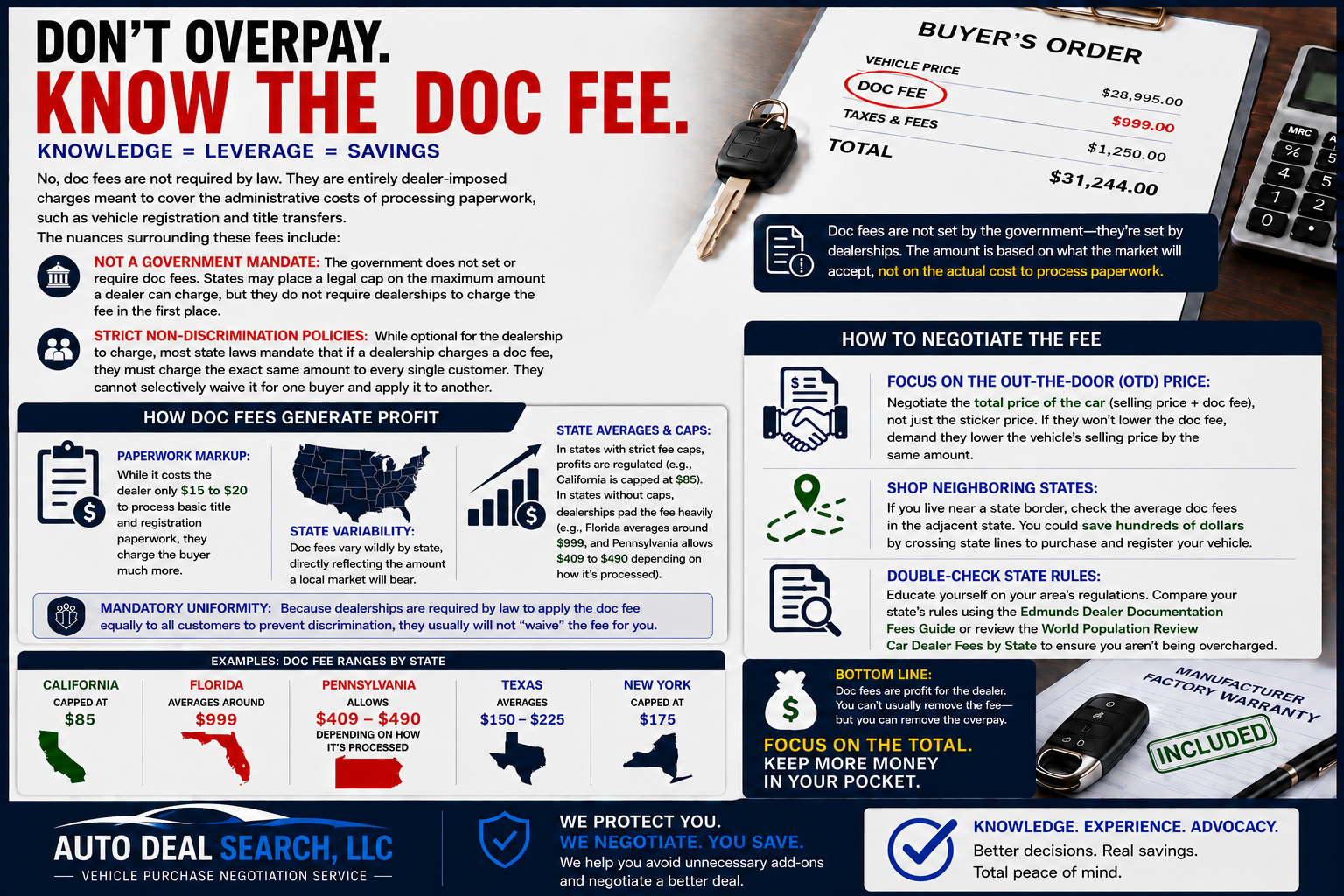
--Excessive documentation fees.
--Unexplained administrative fees.
--Dealer-added accessories not requested.
--Mandatory add-ons.
--Mandatory protection packages.
Online Shopping Red Flags
-Internet Advertisement Concerns
--Price far below market value.
--Stock photos only.
--Limited vehicle photos.
--No undercarriage photos.
--No interior photos.
--Generic vehicle descriptions.
--Unrealistic claims such as "perfect condition.".
Personal Buyer Red Flags
-Emotional Buying Mistakes
--Falling in love with a vehicle before researching.
--Shopping without a budget.
--Shopping without financing approval.
--Ignoring insurance costs.
--Ignoring maintenance costs.
--Purchasing based solely on appearance.
--Buying because of pressure from family or friends.
--Purchasing without comparing alternatives.
The Biggest Red Flag of All
-Any dealership that :
--Rushes you.
--Discourages questions.
--Refuses a test drive.
--Refuses an independent inspection.
--Refuses written documentation.
--Changes numbers unexpectedly.
--Makes you feel uncomfortable.
If a dealership is trying to rush your decision, there is usually a reason. A vehicle purchase is one of the largest financial decisions most
consumers make. Take your time, do your research, and never sign paperwork until you fully understand the transaction.