Understanding how dealership employees are compensated can help consumers better understand
the motivations and incentives that influence the vehicle purchasing process. Below are some of the most
common forms of compensation and performance-based incentives used in automotive dealerships.
How Dealership Employees Are Compensated

*Car Salespeople
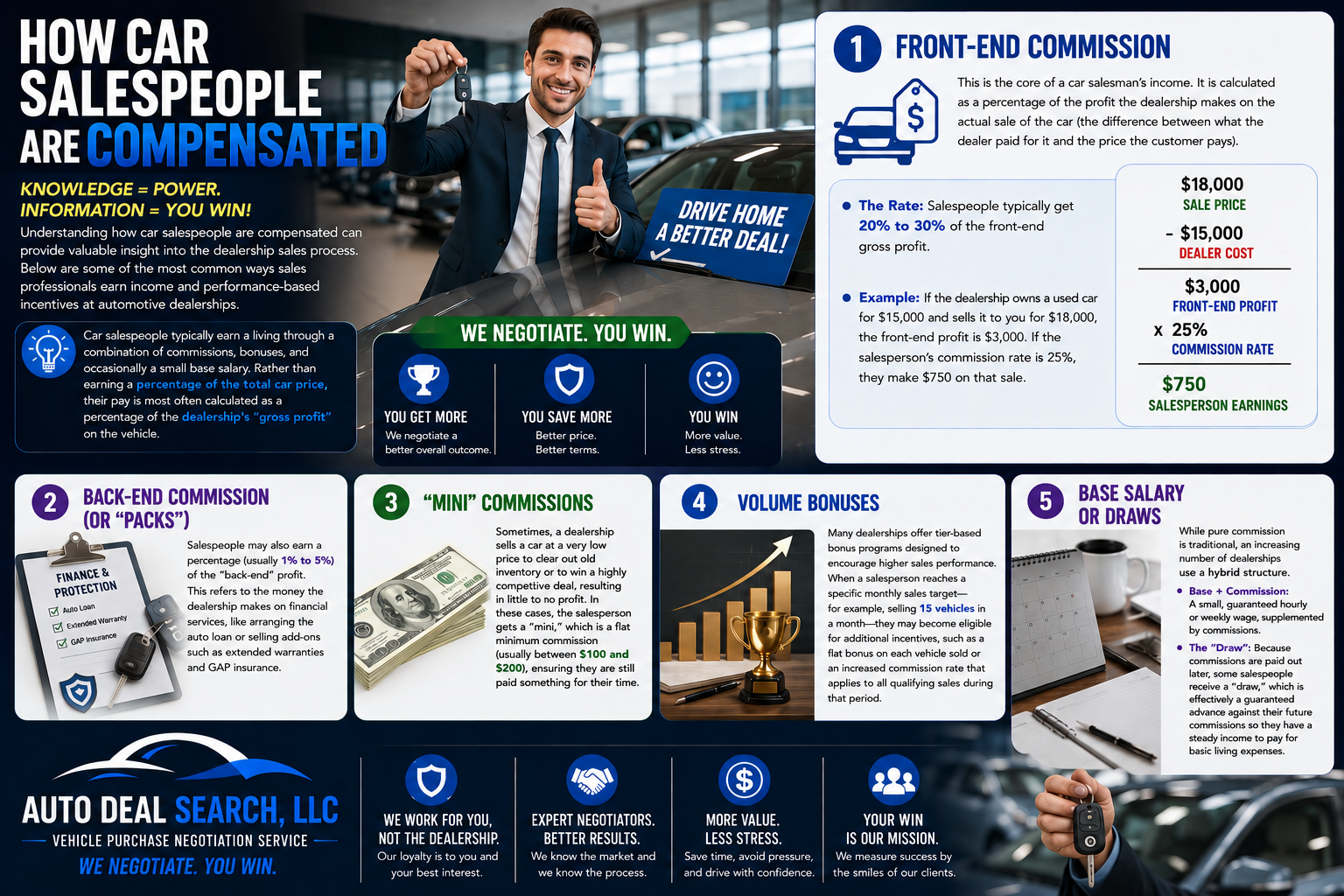
Car salespeople typically earn a living through a combination of commissions, bonuses, and occasionally a small base salary. Rather than earning a percentage of the total car price, their pay is most often calculated as a percentage of the dealership's "gross profit" on the vehicle.
The most common ways dealerships compensate their sales teams include:
1. Front-End Commission
This is the core of a car salespeople's income. It is calculated as a percentage of the profit the dealership makes on the actual sale of the car (the difference
between what the dealer paid for it and the price the customer pays).
-The Rate: Salespeople typically get 20% to 30% of the front-end gross profit.
-Example: If the dealership owns a used car for $15,000 and sells it to you for $18,000, the front-end profit is $3,000. If the salesperson's commission rate is 25%, they make $750 on that sale.
2. Back-End Commission (or "Packs")
Salespeople may also earn a percentage (usually 1% to 5%) of the "back-end" profit. This refers to the money the dealership makes on financial services, like
arranging the auto loan or selling add-ons such as extended warranties and GAP insurance.
3. "Mini" Commissions
Sometimes, a dealership sells a car at a very low price to clear out old inventory or to win a highly competitive deal, resulting in little to no profit. In these cases, the salespeople gets a "mini," which is a flat minimum commission (usually between $100 and $200), ensuring they are still paid something for their time.
4. Volume Bonuses
Many dealerships offer tier-based bonus programs designed to encourage higher sales performance. When a salespeople reaches a specific monthly sales target —for example, selling 15 vehicles in a month—they may become eligible for additional incentives, such as a flat bonus on each vehicle sold or an increased commission rate that applies to all qualifying sales during that period.
5. Base Salary or Draws
While pure commission is traditional, an increasing number of dealerships use a hybrid structure.
-Base + Commission : A small, guaranteed hourly or weekly wage, supplemented by commissions.
-The "Draw" : Because commissions are paid out later, some salespeople receive a "draw," which is effectively a guaranteed advance against their future commissions so they have a steady income to pay for basic living expenses.
Split Deal
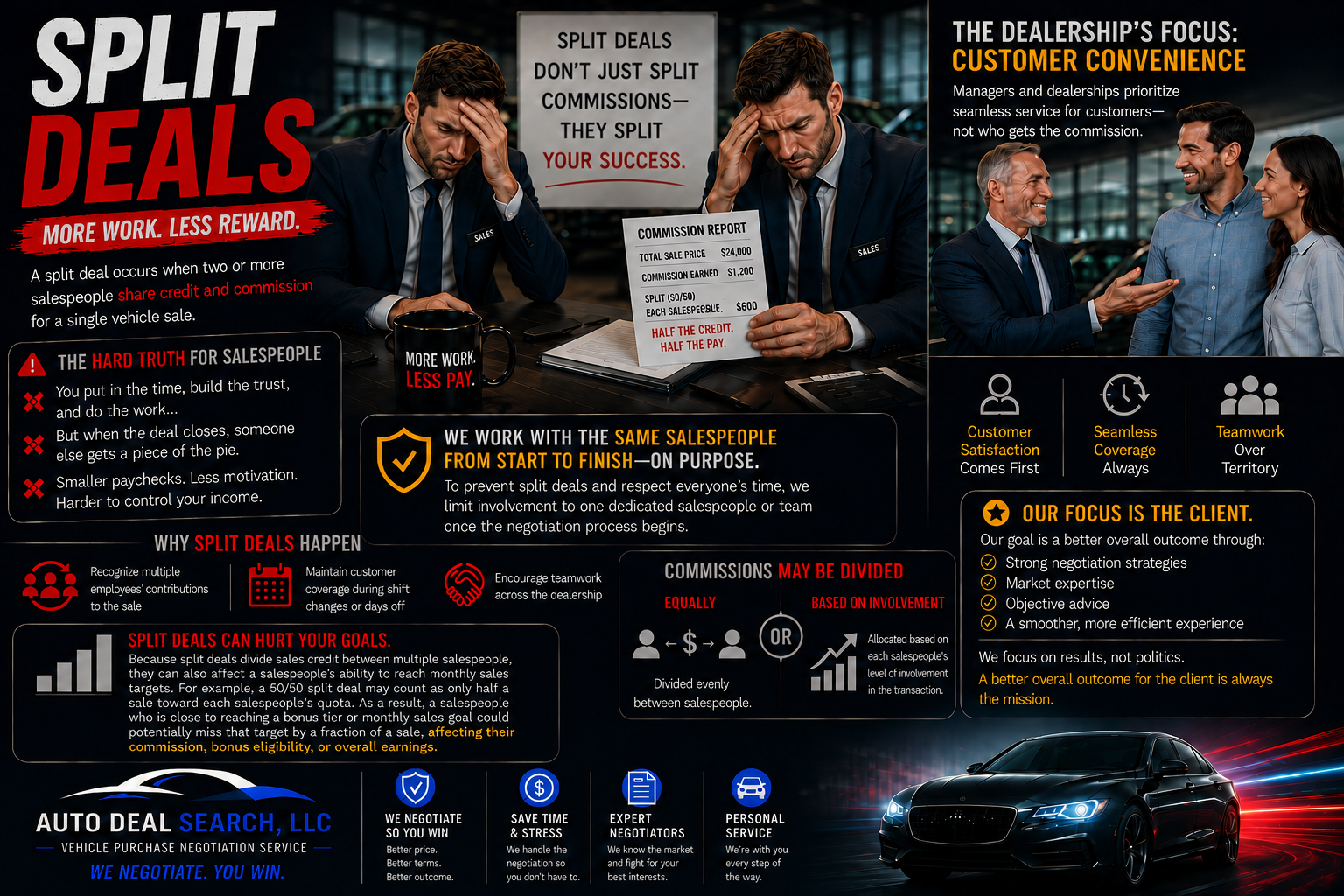
A split deal occurs when two or more salespeople share credit and commission for a single vehicle sale. For example, if a customer initially works with one
salespeople but completes the purchase with another, the commission and sales credit may be divided between them.
Split deals are commonly used to recognize the contributions of multiple employees, maintain customer coverage during shift changes or days off, and
encourage teamwork within the dealership. Depending on dealership policies, commissions may be divided equally or allocated based on each salespeople's level of involvement in the transaction. But because split deals divide sales credit between multiple salespeople, they can also affect a salesperson's ability to reach monthly sales targets. For example, a 50/50 split deal may count as only half a sale toward each salespeople's quota. As a result, a salespeople who is close to reaching a bonus tier or monthly sales goal could potentially miss that target by a fraction of a sale, affecting their commission, bonus eligibility, or overall earnings.
Sales Floor System
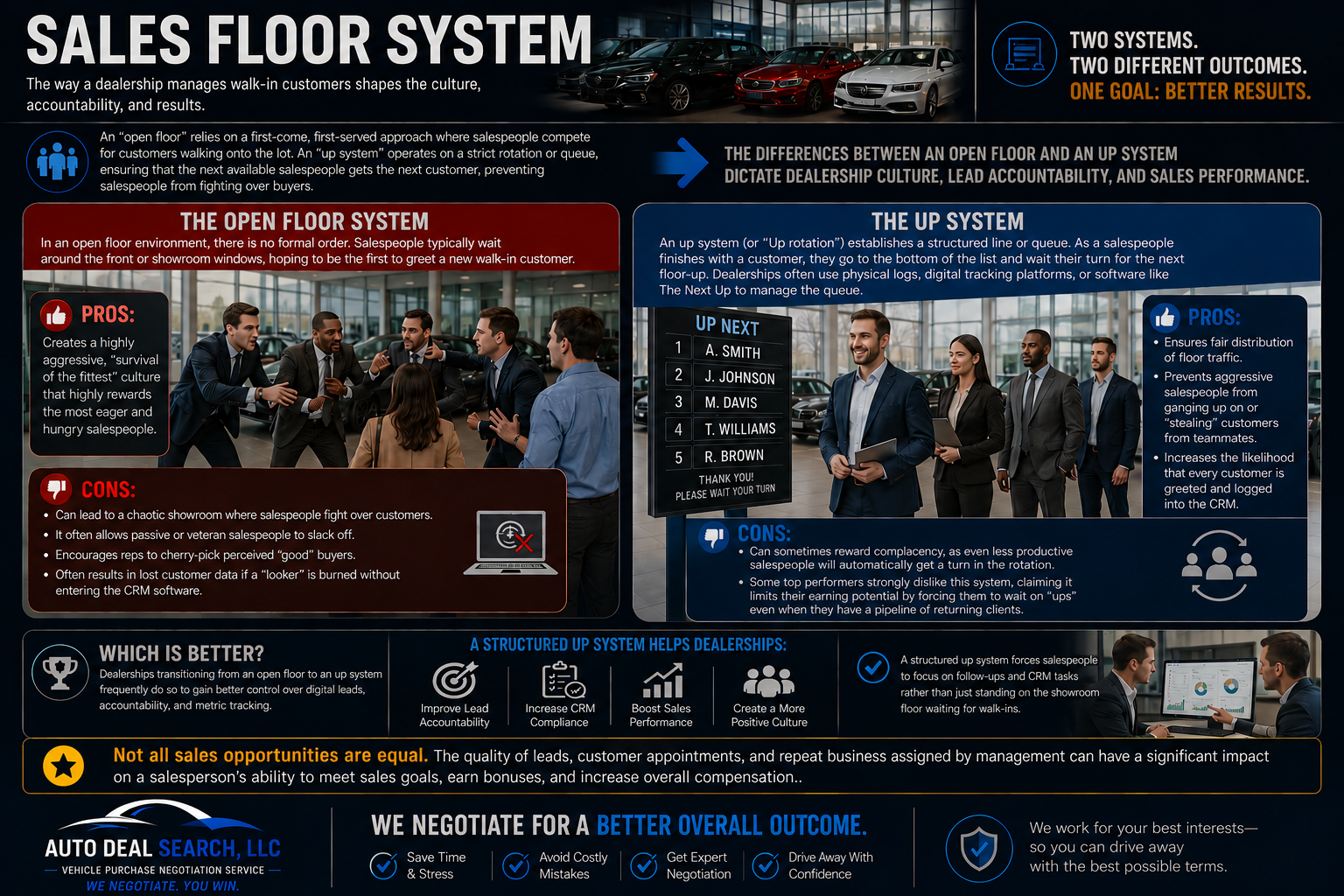
An "open floor" relies on a first-come, first-served approach where salespeople compete for customers walking onto the lot. An "up system" operates on a strict rotation or queue, ensuring that the next available salespeople gets the next customer, preventing salespeople from fighting over buyers.
The differences between an open floor and an up system dictate dealership culture, lead accountability, and sales performance:
-The Open Floor System
In an open floor environment, there is no formal order. Salespeople typically wait around the front or showroom windows, hoping to be the first to greet a new walk-in customer.
-Pros : Creates a highly aggressive, "survival of the fittest" culture that highly rewards the most eager and hungry salespeople.
-Cons : Can lead to a chaotic showroom where salespeople fight over customers. It often allows passive or veteran salespeople to slack off, encourages reps to cherry-pick perceived "good" buyers, and often results in lost customer data if a "looker" is burned without entering the Customer Relationship Management (CRM) software.
-The Up System
An up system (or "Up rotation") establishes a structured line or queue. As a salespeople finishes with a customer, they go to the bottom of the list and wait their turn for the next floor-up. Dealerships often use physical logs, digital tracking platforms, or software like The Next Up to manage the queue.
-Pros : Ensures fair distribution of floor traffic, prevents aggressive salespeople from ganging up on or "stealing" customers from teammates, and increases the likelihood that every customer is greeted and logged into the CRM.
-Cons : Can sometimes reward complacency, as even less productive salespeople will automatically get a turn in the rotation. Some top performers strongly dislike this system, claiming it limits their earning potential by forcing them to wait on "ups" even when they have a pipeline of returning clients.
Which is Better?
Dealerships transitioning from an open floor to an up system frequently do so to gain better control over digital leads, accountability, and metric tracking.
A structured up system forces salespeople to focus on follow-ups and CRM tasks rather than just standing on the showroom floor waiting for walk-ins.
Not all sales opportunities are equal. The quality of leads, customer appointments, and repeat business assigned by management can have a significant impact on a salespeople's ability to meet sales goals, earn bonuses, and increase overall compensation.
Pay Scale
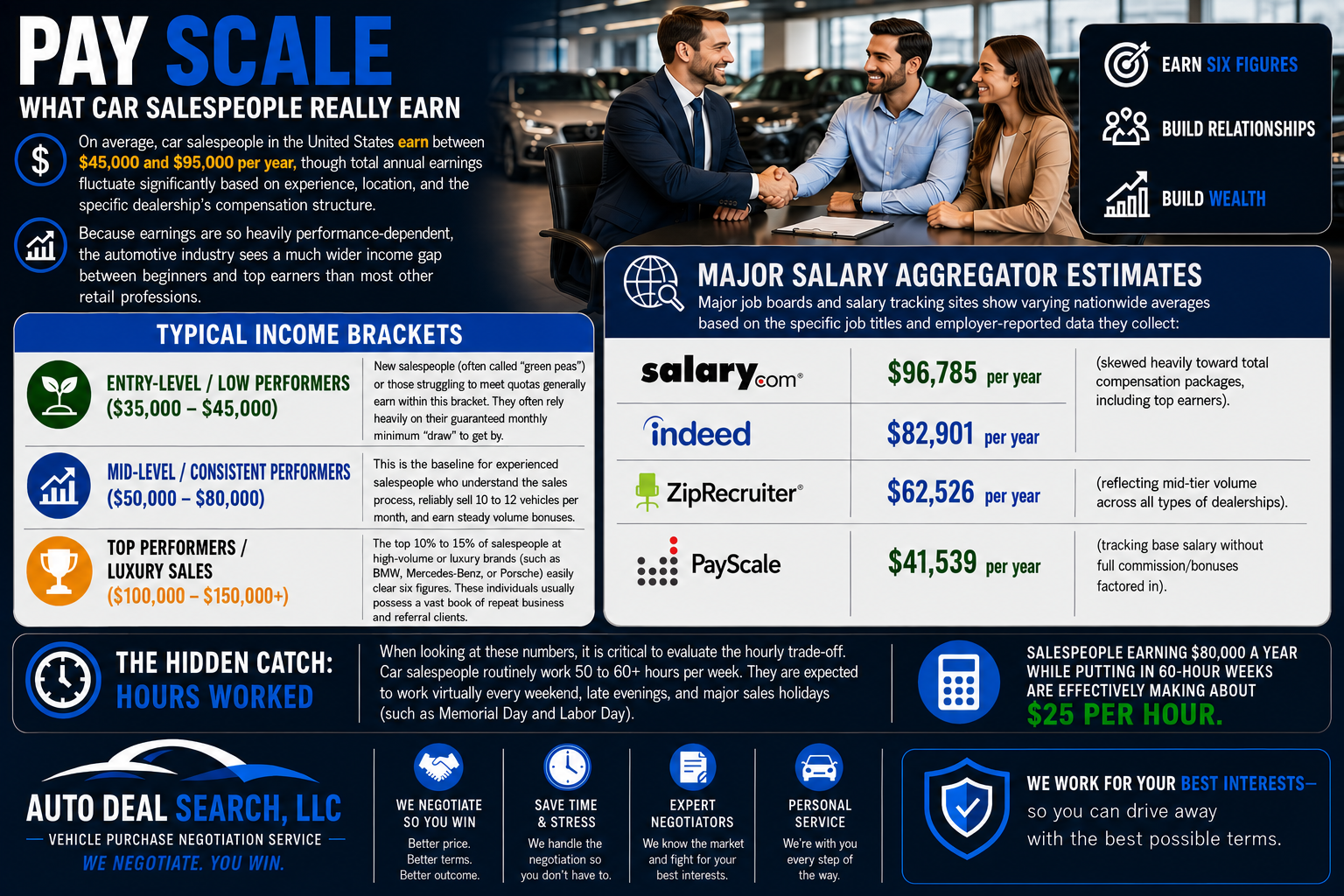
On average, car salespeople in the United States earn between $45,000 and $95,000 per year, though total annual earnings fluctuate significantly based on experience, location, and the specific dealership's compensation structure.
Because earnings are so heavily performance-dependent, the automotive industry sees a much wider income gap between beginners and top earners than most other retail professions.
Typical Income Brackets
-Entry-Level / Low Performers ($35,000 – $45,000) : New salespeople (often called "green peas") or those struggling to meet quotas generally earn within this bracket. They often rely heavily on their guaranteed monthly minimum "draw" to get by.
-Mid-Level / Consistent Performers ($50,000 – $80,000) : This is the baseline for experienced salespeople who understand the sales process, reliably sell 10 to 12 vehicles per month, and earn steady volume bonuses.
-Top Performers / Luxury Sales ($100,000 – $150,000+) : The top 10% to 15% of salespeople at high-volume or luxury brands (such as BMW, Mercedes-Benz, or Porsche) easily clear six figures. These individuals usually possess a vast book of repeat business and referral clients.
Major Salary Aggregator Estimates
Major job boards and salary tracking sites show varying nationwide averages based on the specific job titles and employer-reported data they collect:
-Salary.com : $96,785 per year (skewed heavily toward total compensation packages, including top earners).
-Indeed : $82,901 per year.
-ZipRecruiter : $62,526 per year (reflecting mid-tier volume across all types of dealerships).
-PayScale : $41,539 per year (tracking base salary without full commission/bonuses factored in).
The Hidden Catch: Hours Worked
When looking at these numbers, it is critical to evaluate the hourly trade-off. Car salespeople routinely work 50 to 60+ hours per week. They are expected to work virtually every weekend, late evenings, and major sales holidays (such as Memorial Day and Labor Day). Salespeople earning $80,000 a year while putting in 60-hour weeks are effectively making about $25 per hour.
*Finance & Insurance Manager
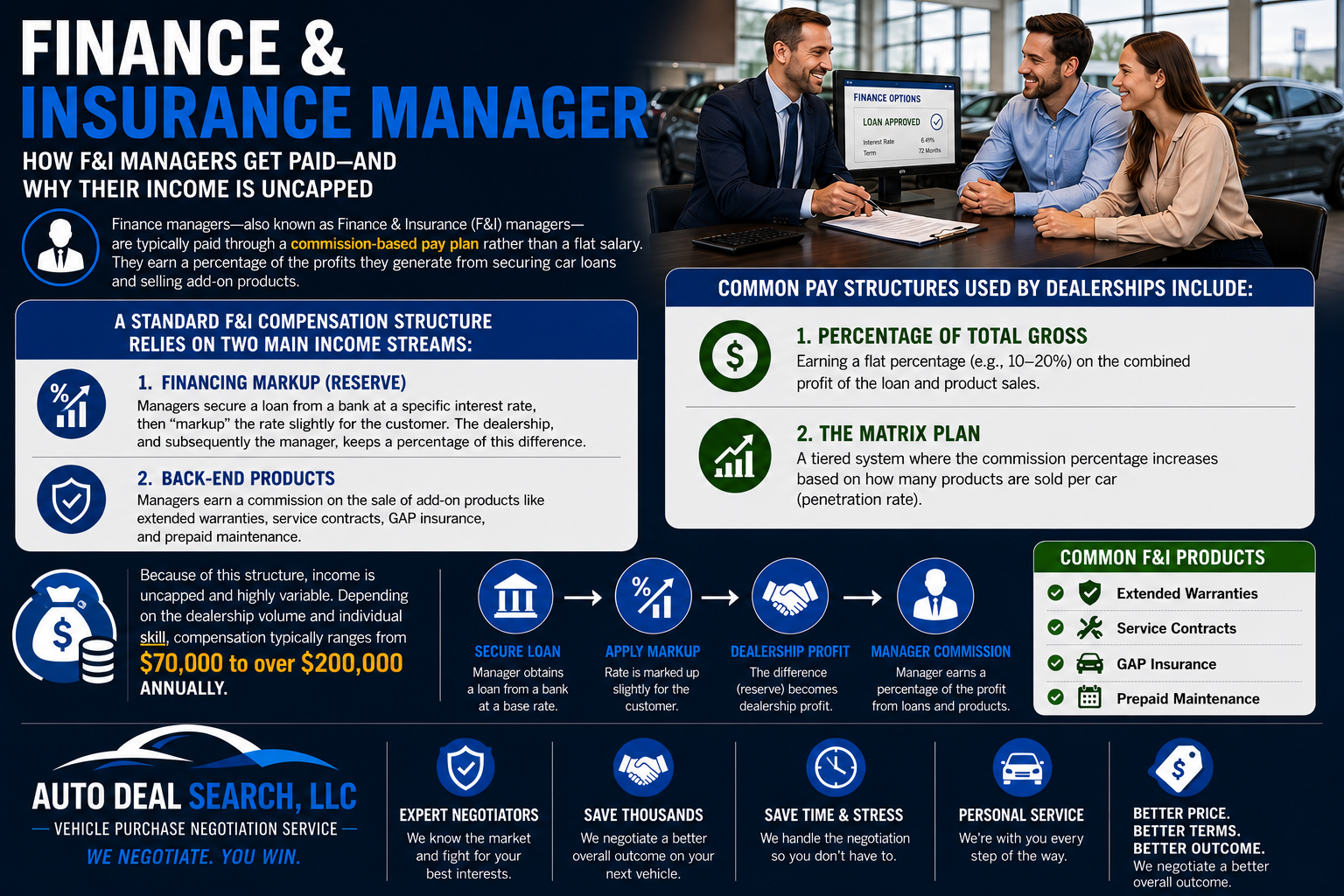
Finance managers—also known as Finance & Insurance (F&I) managers—are typically paid through a commission-based pay plan rather than a flat salary. They earn a percentage of the profits they generate from securing car loans and selling add-on products.
A standard F&I compensation structure relies on two main income streams :
-Financing Markup (Reserve) : Managers secure a loan from a bank at a specific interest rate, then "markup" the rate slightly for the customer. The
dealership, and subsequently the manager, keeps a percentage of this difference.
-Back-End Products : Managers earn a commission on the sale of add-on products like extended warranties, service contracts, GAP insurance, and prepaid maintenance.
Common pay structures used by dealerships include:
-Percentage of Total Gross: Earning a flat percentage (e.g., 10-20%) on the combined profit of the loan and product sales.
-The Matrix Plan: A tiered system where the commission percentage increases based on how many products are sold per car (penetration rate).
Because of this structure, income is uncapped and highly variable. Depending on the dealership volume and individual skill, compensation typically ranges from $70,000 to over $200,000 annually.
*Sales Manager
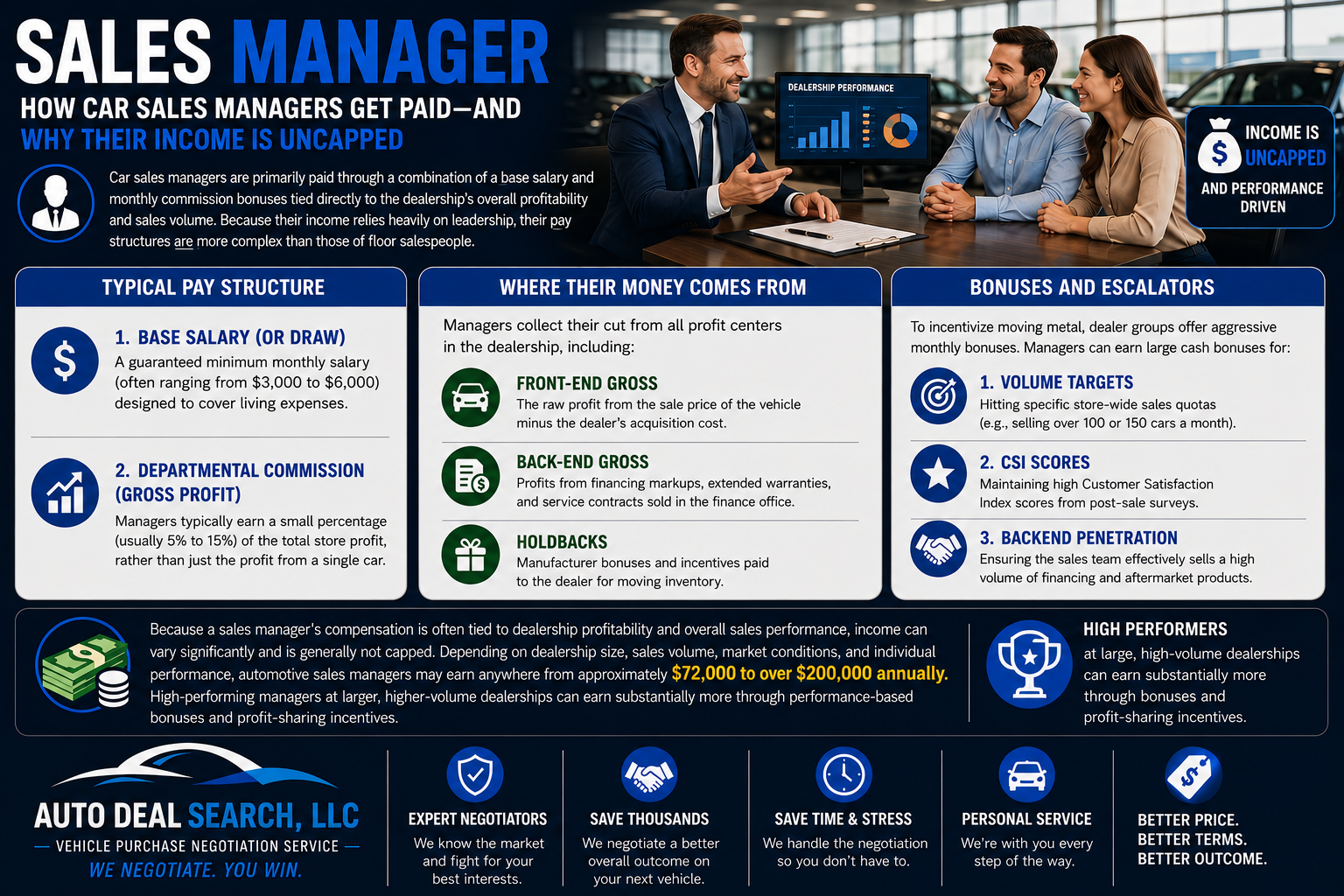
Car sales managers are primarily paid through a combination of a base salary and monthly commission bonuses tied directly to the dealership’s overall profitability and sales volume. Because their income relies heavily on leadership, their pay structures are more complex than those of floor salespeople.
Typical Pay Structure
-Base Salary (or Draw) : A guaranteed minimum monthly salary (often ranging from $3,000 to $6,000) designed to cover living expenses.
-Departmental Commission (Gross Profit) : Managers typically earn a small percentage (usually 5% to 15%) of the total store profit, rather than just the profit from a single car.
Where Their Money Comes From
Managers collect their cut from all profit centers in the dealership, including:
-Front-End Gross : The raw profit from the sale price of the vehicle minus the dealer’s acquisition cost.
-Back-End Gross : Profits from financing markups, extended warranties, and service contracts sold in the finance office.
-Holdbacks : Manufacturer bonuses and incentives paid to the dealer for moving inventory.
Bonuses and Escalators
To incentivize moving metal, dealer groups offer aggressive monthly bonuses. Managers can earn large cash bonuses for:
-Volume Targets : Hitting specific store-wide sales quotas (e.g., selling over 100 or 150 cars a month).
-CSi Scores : Maintaining high Customer Satisfaction Index scores from post-sale surveys.
-Backend Penetration : Ensuring the sales team effectively sells a high volume of financing and aftermarket products.
Because a sales manager's compensation is often tied to dealership profitability and overall sales performance, income can vary significantly and is generally not capped. Depending on dealership size, sales volume, market conditions, and individual performance, automotive sales managers may earn anywhere from
approximately $72,000 to over $200,000 annually. High-performing managers at larger, higher-volume dealerships can earn substantially more through
performance-based bonuses and profit-sharing incentives.
*General Manager
A car dealership General Manager (GM) is typically paid through a combination of a base salary and performance-based bonuses tied directly to the
profitability and volume of the dealership. Total compensation often aligns with the overall success of the store.
1. Base Salary
GMs usually receive a guaranteed base salary, which provides financial stability. This base amount varies depending on the size of the dealership, the brand (e.g., luxury vs. economy), and the geographic location.
2. Percentage of Gross Profits (The Bonus)
The bulk of a GM's income comes from monthly bonuses, typically structured as a percentage of the dealership's total gross profit.
-Front-End & Back-End : This profit includes both the "front-end" (the profit made on the actual sale of vehicles) and the "back-end" (profits from
financing, extended warranties, and aftermarket products).
-Sliding Scale : Many compensation plans use a sliding scale or tiered percentage structure. If the GM hits higher volume or profit tiers, their percentage on the entire gross profit increases.
3. Volume and Target Bonuses
In addition to the overall gross profit, GMs frequently earn flat bonuses for achieving specific dealership milestones, such as:
-Manufacturer Targets : Hitting specific quotas set by the auto manufacturer (e.g., Honda or Ford).
-Customer Satisfaction : Meeting or exceeding benchmarks for Customer Satisfaction Index (CSI) scores.
-Departmental Goals : Specific bonuses for driving high performance in the Service or Parts departments.
Expected Earnings
Because a General Manager's compensation is often tied to dealership profitability, sales performance, and overall operational success, earnings can vary
significantly and are generally not capped. Depending on dealership size, sales volume, market conditions, and individual performance, compensation may
include salary, performance-based bonuses, and profit-sharing incentives. The average total compensation for a dealership General Manager is often around $182,000 per year. However, top-performing General Managers at large, high-volume dealerships can earn well in excess of $300,000 annually when
performance bonuses and profit-sharing incentives are maximized.